 Koper: R1-208, Črni Kal - Kortine, Stepani
Among the places of the Slovene Littoral, Koper stands out as Slovenia’s principal commercial port on the Adriatic Sea. Its compact historic centre developed on an island later joined to the mainland. Venetian rule left a lasting mark around Tito Square, where the Gothic-Renaissance Praetorian Palace remains the city’s best-known civic building. Beyond the waterfront, Koper’s municipality extends into the hills of Slovene Istria, a varied hinterland of vineyards, olive groves and woodland. The meeting of port infrastructure, an Italianate old town and a Karst-influenced interior gives Koper a character quite distinct from Slovenia’s inland cities.
Generated by AI

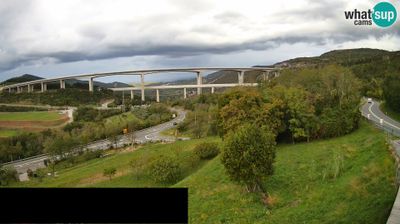




Koper combines a compact Venetian old town with the purposeful scale of Slovenia’s principal commercial port, reflecting its position on the Adriatic’s Gulf of Trieste. Its historic centre was once an island, and its narrow streets still converge on Tito Square, where the 15th-century Praetorian Palace recalls the period of Venetian rule. The port remains central to the city’s modern identity, linking Slovenia with maritime trade routes across the northern Adriatic. Koper also belongs to Slovenia’s bilingual coastal area, where Italian has official status alongside Slovene. Find related webcams in the surrounding area to build a fuller picture of Koper and the Slovenian coast.
10 webcams
Upravna enota Koper combines a Mediterranean shoreline with a limestone hinterland in a way that reflects its position between the Adriatic Sea and Slovenia’s interior. Centred on Koper, it forms part of Slovenian Istria on the Gulf of Trieste, where the Bay of Koper meets low hills marked by vineyards and olive groves. The old town bears the imprint of centuries of Venetian rule: Tito Square is framed by the Praetorian Palace and the Cathedral of the Assumption. Koper is also Slovenia’s principal commercial port, lending this short stretch of coast a working, outward-looking character alongside its Italianate urban fabric. Browse other webcams across Slovenian Istria to place this coastal setting in a wider geographic context.
18 webcams
Slovenia occupies a meeting point of the Alps, the Pannonian Plain, the Dinaric mountains and the Adriatic coast in south-central Europe. The Julian Alps rise in the northwest, where Triglav is the country’s highest mountain, while the Soča River is known for its clear turquoise water. Karst terrain has shaped caves such as Postojna Cave and the Škocjan Caves, a UNESCO World Heritage site. Ljubljana combines a riverside old town with works by architect Jože Plečnik; farther east, wine-growing regions and thermal springs add another dimension. Slovenian food reflects Alpine, Mediterranean and Balkan influences. Find related webcams in the surrounding area to build a fuller picture of Slovenia and the northern Adriatic.
784 webcams