 Sainte-Rose: Cratère Fontaine
Cratère Fontaine lies on a volcanic ridge within the Enclos Fouqué caldera in southeastern Réunion, a setting continually reshaped by eruptions of Piton de la Fournaise. This basaltic shield volcano dominates the island’s east, rising above the Indian Ocean and channelling many lava flows through the open-sided Enclos towards the coast. Fontaine belongs to the stark mineral terrain created by successive eruptions, where black lava fields, scoria and sparse pioneer vegetation trace the volcano’s changing contours. The wider massif forms part of Réunion National Park, included in the UNESCO World Heritage property “Pitons, cirques and remparts of Réunion Island” since 2010. Sainte-Rose, on the east coast, is closely connected with this volcanic landscape and the routes leading towards the caldera.
Generated by AI






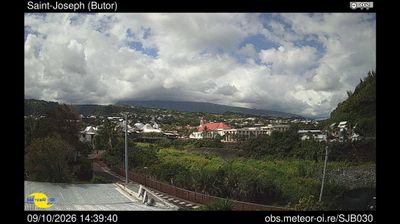

Sainte-Rose sits on Réunion’s eastern Indian Ocean coast, where the slopes of Piton de la Fournaise descend toward a shoreline repeatedly reshaped by lava. The commune includes the Grand Brûlé sector, crossed by the coastal road through young volcanic terrain on the volcano’s southeastern flank. At Piton Sainte-Rose, the church of Notre-Dame-des-Laves recalls the 1977 eruption, when lava divided around the building rather than destroying it. Sugar-cane fields and humid coastal vegetation contrast with black volcanic rock along this active side of the island. Find related webcams around Sainte-Rose and Réunion’s volcanic east coast to build a fuller picture of this part of the island.
4 webcams
Built around the volcanic slopes of Piton des Neiges, Réunion grew into a French overseas department in the Indian Ocean. The island’s rugged interior includes the cirques of Mafate, Salazie and Cilaos, while Piton de la Fournaise remains one of the world’s most active volcanoes. Much of this dramatic terrain forms part of the UNESCO-listed Pitons, cirques and ramparts of Réunion. Along the coast, towns, sugar-cane fields and Indian Ocean beaches reveal a different rhythm. Creole traditions reflect African, European, Malagasy, Indian and Chinese influences, heard in language and tasted in local cooking. Browse other webcams across Réunion to place this volcanic island in its wider Indian Ocean context.
24 webcams
The Atlantic and Mediterranean coastlines, together with the Alps, Pyrenees and broad river basins, define much of France — they support maritime trade, farming, wine regions and travel throughout the year. The Seine runs through Paris, where the Eiffel Tower and the Louvre are among Europe’s most recognised landmarks. The Loire Valley is known for Renaissance châteaux, while Mont-Saint-Michel rises from a tidal bay in Normandy. Regional food traditions are equally distinctive, from Breton seafood to Provençal cooking, with bread, cheese and wine central to everyday life. France’s global cultural influence is evident in its language, literature, fashion and cinema. View additional webcams nearby to better understand how France’s coasts, plains and mountain borders relate to their surroundings.
1.9K webcams