 Saint-Philippe: Volcan Piton Fournaise (Bory)
Bory Crater has served as a named landmark on Réunion’s Piton de la Fournaise since the early 19th century. It lies in the summit zone of one of the world’s most active shield volcanoes, within the vast Enclos Fouqué caldera. Piton de la Fournaise occupies Réunion’s southeast, where volcanic slopes run down toward the Indian Ocean and the commune of Saint-Philippe. Bare basaltic ground and crater walls reflect a landscape repeatedly reshaped by eruptions rather than a settled mountain environment. The massif forms part of the UNESCO World Heritage-listed Pitons, cirques and remparts of Réunion, inscribed in 2010 for its exceptional geology and landforms.
Generated by AI





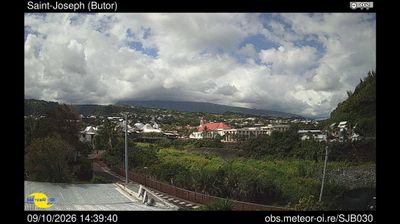

Saint-Philippe lies along Réunion’s southeastern Indian Ocean coast, where humid forest meets black volcanic terrain shaped by eruptions of Piton de la Fournaise. This small commune belongs to the island’s wild south, a wetter and less urbanised stretch of shore where lava flows have repeatedly altered the land. The nearby Mare Longue forest preserves a rare remnant of Réunion’s lowland rainforest, while the Jardin des Parfums et des Épices presents tropical plants and aromatic crops. Roads through the commune link coastal hamlets with the volcanic country toward Grand Brûlé. Explore nearby locations that provide complementary perspectives on Réunion’s volcanic southeast.
1 webcam
Built around the volcanic slopes of Piton des Neiges, Réunion grew into a French overseas department in the Indian Ocean. The island’s rugged interior includes the cirques of Mafate, Salazie and Cilaos, while Piton de la Fournaise remains one of the world’s most active volcanoes. Much of this dramatic terrain forms part of the UNESCO-listed Pitons, cirques and ramparts of Réunion. Along the coast, towns, sugar-cane fields and Indian Ocean beaches reveal a different rhythm. Creole traditions reflect African, European, Malagasy, Indian and Chinese influences, heard in language and tasted in local cooking. Browse other webcams across Réunion to place this volcanic island in its wider Indian Ocean context.
25 webcams
The Atlantic and Mediterranean coastlines, together with the Alps, Pyrenees and broad river basins, define much of France — they support maritime trade, farming, wine regions and travel throughout the year. The Seine runs through Paris, where the Eiffel Tower and the Louvre are among Europe’s most recognised landmarks. The Loire Valley is known for Renaissance châteaux, while Mont-Saint-Michel rises from a tidal bay in Normandy. Regional food traditions are equally distinctive, from Breton seafood to Provençal cooking, with bread, cheese and wine central to everyday life. France’s global cultural influence is evident in its language, literature, fashion and cinema. View additional webcams nearby to better understand how France’s coasts, plains and mountain borders relate to their surroundings.
2.1K webcams