 Schwangau: Füssen - Schloss Hohenschwangau, Blick zur königlichen Kristalltherme mit Forggensee im Hintergrund

The landscape around Schwangau is a broad Alpine foothill valley of meadows, lakes and wooded slopes, which has shaped both the built environment and local life. Set in the Bavarian Allgäu near the Austrian border, the municipality occupies part of the Lech valley beside Forggensee, a reservoir formed by the Lech. Farms and compact settlements remain integral to the valley floor, while the Ammergau Alps rise nearby. Schwangau is internationally associated with the royal castles of Neuschwanstein and Hohenschwangau. King Ludwig II began Neuschwanstein in 1869 as an idealised medieval-style retreat; it was never completed. Hohenschwangau, rebuilt in the 19th century for the Bavarian royal family, was Ludwig’s childhood home.
Generated by AI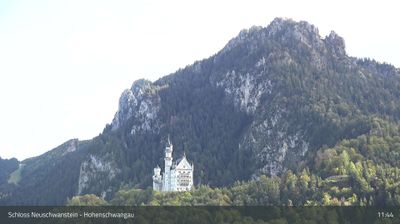
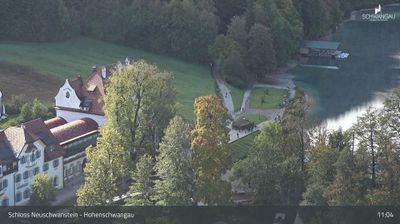

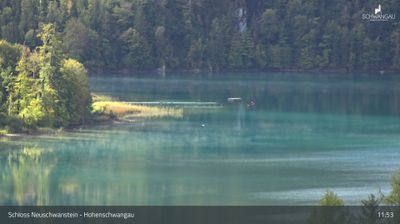
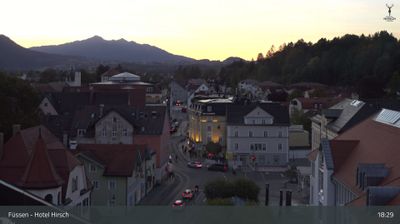
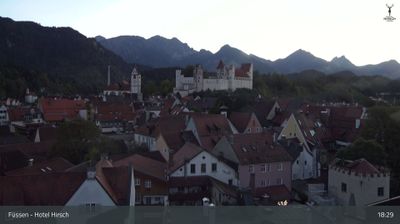
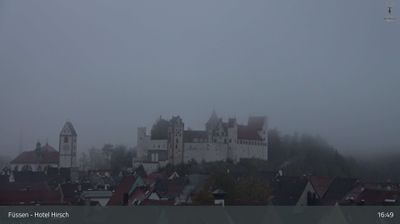

Tucked along the Lech in the northern foothills of the Bavarian Alps, Schwangau is a place whose character is shaped by its lakes, wooded slopes and Alpine setting. The village is closely associated with Neuschwanstein, the elaborate 19th-century castle commissioned by King Ludwig II, which rises above the nearby Alpsee. Hohenschwangau Castle, where Ludwig spent much of his childhood, stands nearby and recalls the region’s royal past. Paths and cycling routes lead through the open Lech valley, while the mountains form a constant presence beyond the meadows. Discover other points of interest through webcams located across the Bavarian Alps.
9 webcams
Built around the early medieval Duchy of Bavaria, Bavaria grew into Germany’s largest federal state. The Danube crosses its broad centre, while the Bavarian Alps form its southern edge and include the Zugspitze, Germany’s highest mountain. Munich is the state capital and the home of Oktoberfest, a festival rooted in an 1810 royal wedding. Beyond the metropolis, Franconia’s vineyards, Swabian towns and Alpine resorts reveal how varied this part of Germany can be. Browse additional webcams from the surrounding area to extend your view of Bavaria.
862 webcams
Germany stretches from the North Sea and Baltic Sea coasts to the Alps on its southern border, encompassing northern plains, river valleys and forested uplands. The Rhine, Danube and Elbe have long connected its regions, while the Black Forest and Bavarian Alps give the south a more dramatic relief. Berlin’s Brandenburg Gate and Museum Island reflect the capital’s role in German history and culture. Cologne Cathedral, a UNESCO World Heritage Site, rises above the Rhine, and the Bauhaus movement, founded in Weimar in 1919, transformed modern design far beyond Germany. Regional cooking, Christmas markets and brewing traditions bring further character to daily life. Browse additional webcams from the surrounding area to extend your view of Germany.
2.8K webcams