 Fussen: Schwangau - Hotel Hirsch, Hohes Schloss

Tucked along the Lech at the northern edge of the Allgäu Alps, Füssen is a town whose character is shaped by its Alpine setting and river crossing. The old town grew beneath the Hohes Schloss, a late-Gothic residence of the prince-bishops of Augsburg whose painted façades and towers form one of the town’s defining monuments. Its rooms house a branch of the Bavarian State Painting Collections. Nearby, the former Benedictine Abbey of St Mang recalls Füssen’s long religious importance. The town is also associated with the historic craft of lute and violin making, and lies close to the Austrian border among the foothills and lakes of southern Bavaria.
Generated by AI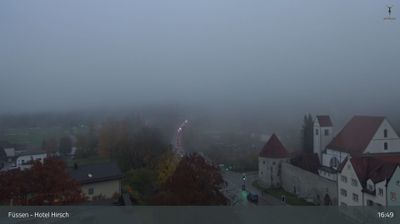
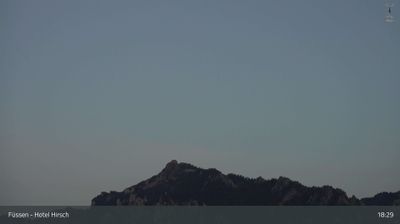
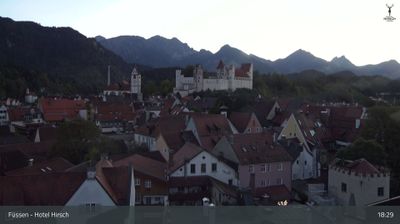
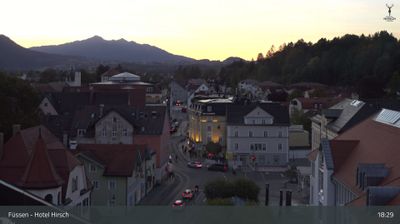
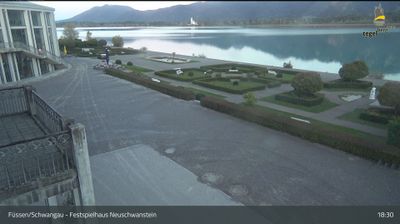

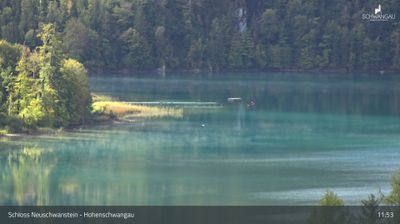

Set along the Lech at the northern foot of the Allgäu Alps, Füssen is a town whose character has been shaped by its position between Alpine routes and the Bavarian plain. Its old centre rises beneath the late-Gothic Hohes Schloss, once the summer residence of the prince-bishops of Augsburg; the building now houses a branch of the Bavarian State Painting Collections. Füssen also has a long tradition of lute and violin making, reflected in the Museum of the City of Füssen in the former St Mang Abbey. The Forggensee lies just north of town, while Neuschwanstein Castle stands at nearby Hohenschwangau. Browse other webcams across Bavaria to place this Alpine foothill setting in a wider geographic context.
10 webcams
Built around the early medieval Duchy of Bavaria, Bavaria grew into Germany’s largest federal state. The Danube crosses its broad centre, while the Bavarian Alps form its southern edge and include the Zugspitze, Germany’s highest mountain. Munich is the state capital and the home of Oktoberfest, a festival rooted in an 1810 royal wedding. Beyond the metropolis, Franconia’s vineyards, Swabian towns and Alpine resorts reveal how varied this part of Germany can be. Browse additional webcams from the surrounding area to extend your view of Bavaria.
862 webcams
Germany stretches from the North Sea and Baltic Sea coasts to the Alps on its southern border, encompassing northern plains, river valleys and forested uplands. The Rhine, Danube and Elbe have long connected its regions, while the Black Forest and Bavarian Alps give the south a more dramatic relief. Berlin’s Brandenburg Gate and Museum Island reflect the capital’s role in German history and culture. Cologne Cathedral, a UNESCO World Heritage Site, rises above the Rhine, and the Bauhaus movement, founded in Weimar in 1919, transformed modern design far beyond Germany. Regional cooking, Christmas markets and brewing traditions bring further character to daily life. Browse additional webcams from the surrounding area to extend your view of Germany.
2.8K webcams