 Aínsa: Plaza Mayor
Among the places of Aragon, Aínsa stands out for its preserved medieval core on a promontory above the meeting of the Ara and Cinca rivers. Plaza Mayor is the town’s principal civic space: an unusually broad, stone-paved rectangle bordered by arcaded houses whose muted masonry reflects the building traditions of Sobrarbe. It opens beside Aínsa Castle, a fortified complex that has guarded this strategic site since the Middle Ages. Above the square, the Romanesque church of Santa María forms part of the old town’s compact skyline. Aínsa lies in the Pyrenean foothills, within the Sobrarbe comarca, where mountain valleys converge around the two rivers. Its narrow streets, arches and fortifications give the town a distinctive northern Aragonese character.
Generated by AI
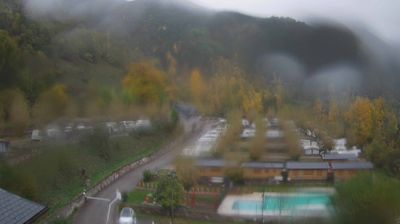

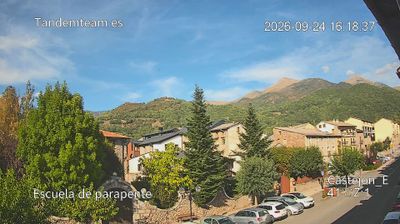


The landscape around Aínsa is defined by the meeting of the Ara and Cinca rivers beneath the central Pyrenees, which has shaped both the town’s hilltop form and its role as a service centre for Sobrarbe. The walled old quarter rises above the confluence, with the broad Plaza Mayor and Aínsa Castle recalling the settlement’s strategic medieval position. Beside the square, the Romanesque Church of Santa María is one of the town’s key monuments. Aínsa also lies close to Ordesa y Monte Perdido National Park, whose high valleys and limestone massifs define this part of Aragón. See how Aínsa fits between the Ara and Cinca valleys by browsing webcams across Sobrarbe.
3 webcams
Aragon combines the dry plains of the Ebro basin with high Pyrenean terrain in a way that reflects its position between central Spain and the French border mountains. Zaragoza, the regional capital on the Ebro River, is anchored by the Basilica of Our Lady of the Pillar and the Aljafería Palace, a major example of Islamic architecture in Spain. Beyond the city, the region extends from cultivated lowlands to the Pyrenees, where valleys and protected mountain areas shape a markedly different climate and settlement pattern. Aragonese identity is also expressed through distinctive Mudéjar architecture, recognised by UNESCO in several towns. Continue with other webcams from the area to see how this part of northeastern Spain connects regionally.
46 webcams
Spain extends from the Cantabrian coast to the Canary Islands, encompassing Atlantic shores, Mediterranean beaches and the broad interior Meseta. The Pyrenees form its northeastern frontier, while the Guadalquivir crosses Andalusia on its way to the Atlantic. Madrid anchors the country’s political and cultural life, but distinct regional identities are central to Spain’s character: Catalonia, the Basque Country, Galicia and Andalusia each have their own languages or strong local traditions. Granada’s Alhambra is a major monument of the medieval Nasrid dynasty, and Santiago de Compostela remains the destination of the Camino de Santiago. Browse related webcams around the Iberian Peninsula to build a fuller picture of Spain.
1.4K webcams