 Nin: Plaža Ninske Vodice
Plaža Ninske Vodice occupies a sandy shoreline on Nin Bay in northern Dalmatia. The bay forms part of a low-lying coastal landscape of shallow Adriatic water, sandy shallows and salt-marsh ground, with the Velebit mountain range on the mainland beyond. It lies beside Nin, whose compact historic centre stands on a small island linked to the shore by bridges. Nin was an important early Croatian centre, and the 9th-century Church of the Holy Cross is among its defining monuments. The town is also known for its salt pans, where salt has long been produced from seawater. Ninske Vodice adds a broad, gently shelving stretch of coast to this heritage setting, unlike the rockier shore associated with much of Dalmatia.
Generated by AI






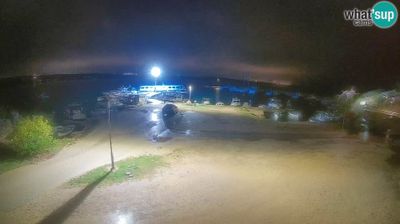
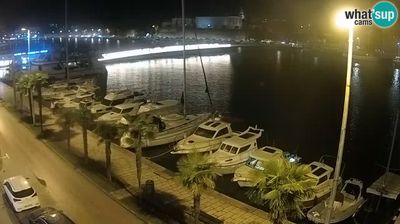

The shallow Nin Lagoon defines the setting of Nin — its old town occupies a small island, linked to the mainland by stone bridges, while sandy shallows and salt pans shape the town’s coastal character. Set on Croatia’s Adriatic coast, Nin was an important Roman municipality; remains of a Roman temple still stand beside its compact historic core. The 9th-century Church of the Holy Cross, a small pre-Romanesque building with distinctive proportions, is among the town’s enduring symbols. Nin is also known for its long tradition of salt production, continued at the Nin Saltworks. Explore nearby webcam locations that provide complementary perspectives on Nin and Zadar County.
2 webcams
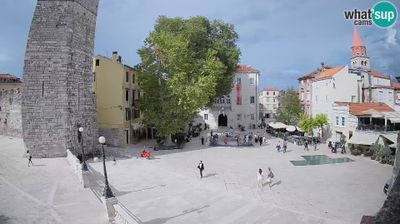
Zadar County extends from the slopes of the Velebit range to the islands of the Zadar archipelago, encompassing a karst hinterland, a long Adriatic shore and scattered islands. Its county seat, Zadar, preserves a Roman Forum beside the early-medieval Church of St Donatus, one of the city’s defining monuments. Beyond the city, Paklenica National Park protects dramatic canyons on Velebit, while the Zrmanja River cuts through inland karst before reaching the sea. Ferries bind the coast to islands including Dugi Otok, Ugljan and Pašman, where olive growing, fishing and stone-built settlements remain part of local life. Browse additional webcams nearby to better understand how Zadar County relates to the Adriatic coast and its islands.
41 webcams
Croatia occupies a long Adriatic coastline in southeastern Europe. Its shore is broken into islands and sheltered coves, while the Dinaric Alps rise inland and the Danube forms part of its eastern border. Dubrovnik’s fortified old city faces the sea, and Split grew around Diocletian’s Palace, a Roman complex begun in the early fourth century. Inland, Plitvice Lakes National Park is known for terraced lakes linked by waterfalls and has been a UNESCO World Heritage Site since 1979. Istrian olive groves, Zagreb and Slavonia’s vineyards reveal distinct regional identities. Explore nearby webcam locations that provide complementary perspectives on the Adriatic coast and Croatia’s interior.
380 webcams