 Weiden in der Oberpfalz: Church St.Michael: Rathaus
Tucked along the Waldnaab in Bavaria’s Upper Palatinate, Weiden in der Oberpfalz is a place whose character is shaped by its position between a compact historic centre and wooded hills beyond the town. The twin spires of St. Josef are a defining element of the skyline; this Catholic parish church was built in the neo-Romanesque style at the turn of the 20th century. Around Oberer Markt, gabled houses and the Old Town Hall recall Weiden’s role as a regional trading town. Ceramic production became an important part of the local economy, and the International Ceramics Museum continues that connection. Today, Weiden combines a walkable centre with the low-lying landscape of the Oberpfalz.
Generated by AI
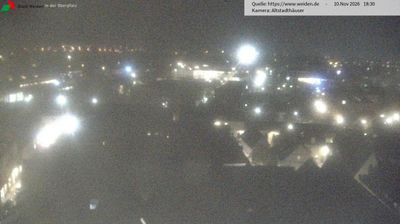

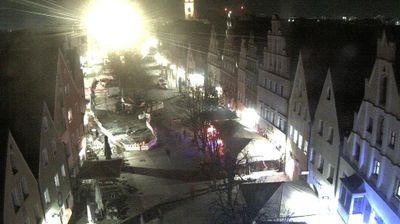


Few cities in Bavaria have a history as closely tied to the medieval trade route between Nuremberg and Prague as Weiden in der Oberpfalz. Set on the Waldnaab in the Upper Palatinate, the city developed as a market centre on this east–west corridor, later known as the Golden Road. Its compact old town centres on the Oberer Markt, where the Renaissance-style Old Town Hall remains a focal point. The tower of St Michael’s Church and the surrounding town houses give the square a distinctly Upper Palatinate character. Weiden also maintains a connection with composer Max Reger, who spent his formative years here. Trace Weiden’s place in the Upper Palatinate by browsing webcams nearby.
5 webcams
Built around the early medieval Duchy of Bavaria, Bavaria grew into Germany’s largest federal state. The Danube crosses its broad centre, while the Bavarian Alps form its southern edge and include the Zugspitze, Germany’s highest mountain. Munich is the state capital and the home of Oktoberfest, a festival rooted in an 1810 royal wedding. Beyond the metropolis, Franconia’s vineyards, Swabian towns and Alpine resorts reveal how varied this part of Germany can be. Browse additional webcams from the surrounding area to extend your view of Bavaria.
576 webcams
Germany stretches from the North Sea and Baltic Sea coasts to the Alps on its southern border, encompassing northern plains, river valleys and forested uplands. The Rhine, Danube and Elbe have long connected its regions, while the Black Forest and Bavarian Alps give the south a more dramatic relief. Berlin’s Brandenburg Gate and Museum Island reflect the capital’s role in German history and culture. Cologne Cathedral, a UNESCO World Heritage Site, rises above the Rhine, and the Bauhaus movement, founded in Weimar in 1919, transformed modern design far beyond Germany. Regional cooking, Christmas markets and brewing traditions bring further character to daily life. Browse additional webcams from the surrounding area to extend your view of Germany.
2.1K webcams