 Surgut
 has served as a river settlement in western Siberia since the late 16th century. Founded in 1594 on the Ob River, it developed from a Russian outpost into one of the principal cities of the Khanty-Mansi Autonomous Okrug–Ugra. The development of West Siberian oil fields transformed the local economy, while broad avenues, large housing districts and substantial road interchanges reflect rapid Soviet and post-Soviet growth. The city stands on the Ob’s right bank amid the flat, forested lowlands of the West Siberian Plain. Surgut’s Museum of Local Lore presents the history of the city and the region’s indigenous peoples.
Generated by AI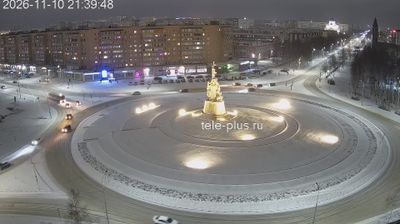

Set along the Ob River in western Siberia, Surgut is a place whose character is shaped by its broad river floodplain and the oil industry that transformed it into one of Russia’s major energy centres. Founded in 1594 as a Russian fortress, the city is among the oldest settlements in the Khanty-Mansiysk Autonomous Okrug–Ugra. Today, its urban fabric combines Soviet-era districts with newer development, while the vast Ob remains a defining presence. The Yugorsky Bridge, opened in 2000, carries a major road crossing over the river near the city. See how Surgut fits within the wider Ob basin by browsing webcams across Ugra.
3 webcams
Khanty-Mansiysk Autonomous Okrug – Ugra extends from the eastern foothills of the Ural Mountains to the Ob–Irtysh lowlands, encompassing vast taiga, river valleys and wetlands of western Siberia. The Ob and Irtysh, two of Russia’s major rivers, shape settlement patterns and transport across this expansive territory. Khanty-Mansiysk, the regional capital, stands on the Irtysh near its confluence with the Ob. Ugra takes its name from the Khanty and Mansi peoples, whose cultures remain an essential part of the region’s identity, alongside an economy strongly associated with oil production. Continue through nearby webcams to explore different parts of Ugra.
5 webcams
Russia has served as a major power between Europe and Asia since the 16th century. Its territory crosses eleven time zones, extending from the Baltic coast and the East European Plain over the Ural Mountains to the Pacific. The Volga, Europe’s longest river, runs through a core of historic Russian settlement, while Lake Baikal in Siberia is the world’s deepest lake. Moscow’s Kremlin and Red Square stand at the centre of the capital’s political and architectural heritage; Saint Petersburg’s Hermitage Museum occupies the Winter Palace. Orthodox churches, Russian-language literature, ballet and long-distance rail travel remain familiar reference points in a country of immense regional contrasts. Continue with other webcams from Russia to see how this part of northern Eurasia connects regionally.
460 webcams