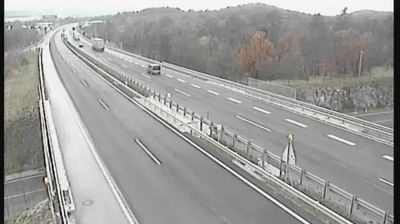
 Sezana: R2-445 - Fernetiči - vzhod, A3 prik., smer Fernetiči
The landscape around Sežana is formed by the limestone Karst Plateau, where thin soils, wooded hollows and stone-built settlements have shaped both the built environment and local life. This Slovenian town lies close to the Italian border in the historic Kras region, whose porous rock gave the world the international geological term karst. Sežana developed as a regional service centre on routes between the interior and Trieste. Its cultural identity is closely linked to the nearby Lipica Stud Farm, founded in 1580, where Lipizzan horses have been bred for centuries. Villages, vineyards and low woodland around the town reflect a region shaped equally by geology and long-established rural life.
Generated by AI



Sežana combines the calm scale of a small town with the limestone terrain of the Karst Plateau in a way that reflects its position beside Slovenia’s Italian border. It stands in the Kras region, where water has shaped sinkholes and underground caves rather than broad river valleys. Nearby Lipica is home to the Lipica Stud Farm, founded in 1580, where the Lipizzaner breed was developed. Sežana was also the birthplace, in 1904, of poet Srečko Kosovel, a major voice in Slovene modernism. Browse other webcams across Slovenia’s Karst region to place Sežana in a wider geographic context.
5 webcams
Among the regions of Slovenia, Upravna enota Sezana stands out for its limestone Karst terrain on the Italian border. The Kras plateau shapes the area with caves, sinkholes, stone-built settlements and the rust-red soil associated with Teran wine. At Škocjan Caves, the Reka River disappears beneath the surface in a vast underground canyon; the caves have been a UNESCO World Heritage site since 1986. Lipica, home to a stud farm established in 1580, remains central to the Lipizzan horse-breeding tradition. Explore further landmarks through webcams across the Karst area of Upravna enota Sezana.
20 webcams
Slovenia occupies a meeting point of the Alps, the Pannonian Plain, the Dinaric mountains and the Adriatic coast in south-central Europe. The Julian Alps rise in the northwest, where Triglav is the country’s highest mountain, while the Soča River is known for its clear turquoise water. Karst terrain has shaped caves such as Postojna Cave and the Škocjan Caves, a UNESCO World Heritage site. Ljubljana combines a riverside old town with works by architect Jože Plečnik; farther east, wine-growing regions and thermal springs add another dimension. Slovenian food reflects Alpine, Mediterranean and Balkan influences. Find related webcams in the surrounding area to build a fuller picture of Slovenia and the northern Adriatic.
775 webcams