 Rancagua
 occupies the eastern Central Valley in Chile’s O’Higgins Region, on the western approaches to the Andes. The city developed as an agricultural and commercial centre on the route south from Santiago, while the Cachapoal River runs through the wider valley. Its eastern outskirts lead toward Machalí and El Teniente, Codelco’s major copper operation in the mountains. Rancagua holds a defining place in Chilean independence history: the Battle of Rancagua was fought here in 1814, and its events are commemorated at Plaza de los Héroes, the city’s principal square. Broad roads, low-rise neighbourhoods and the serrated Andean foothills give this part of the urban area a distinctly inland Chilean character.
Generated by AI
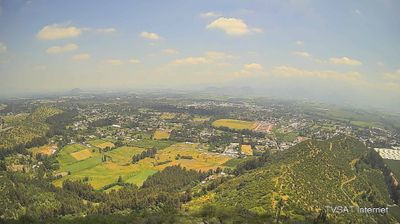

Rancagua has served as an agricultural market town in Chile’s Central Valley since its founding in 1743. It is the capital of the O’Higgins Region, set near the Cachapoal River with the Andes rising to the east. Plaza de los Héroes marks the site of the 1814 Battle of Rancagua, a pivotal defeat in Chile’s struggle for independence. The city is also closely associated with Chilean rodeo: its Medialuna Monumental hosts the annual National Rodeo Championship. Farming in the Cachapoal valley and the nearby El Teniente copper mine have long shaped the local economy. Browse additional webcams from the surrounding area to extend your view of the Cachapoal valley and central Chile.
2 webcams
O'Higgins Region combines fertile central valleys with rugged Andean terrain in a way that reflects its position between Chile's Pacific coast and the high cordillera. Around San Fernando, the Colchagua Valley is one of Chile's established wine-growing areas, where vineyards stand alongside productive farmland. The Rapel River system shapes much of the interior and feeds Lake Rapel, a large reservoir used for recreation. On the coast, Pichilemu is closely associated with surfing, while Rancagua serves as the regional capital. The region is named for Bernardo O'Higgins, a leading figure in Chilean independence. Discover other points of interest through webcams located across O'Higgins Region.
4 webcams
Among the countries of South America, Chile stands out for its exceptional north-to-south extent between the Andes and the Pacific Ocean. The Atacama Desert in the north is one of the driest places on Earth, while the south reaches into Patagonia, where Torres del Paine National Park is known for its jagged granite peaks, glaciers and lakes. Chile also includes Rapa Nui, the Pacific island famed for its monumental moai statues. In Valparaíso, steep hills, funicular railways and colourful historic neighbourhoods reflect the country’s maritime past; its historic quarter is a UNESCO World Heritage Site. Find related webcams in the surrounding area to build a fuller picture of Chile’s Pacific coast and Andean regions.
104 webcams