 Piran: Krajinski park Strunjan
Built around a maritime salt trade, Piran developed into a historic coastal town on Slovenia’s Adriatic shore. At the southern end of its municipality, the Sečovlje Salt Pans form a working wetland where the Dragonja reaches the sea near the Croatian border. Salt has been harvested here since the 13th century, and the protected area preserves the rectilinear ponds, channels and embankments of that craft. The Lera section remains in use for production, while Fontanigge records the older, abandoned salt-making landscape. Rather than an urban waterfront, this is a low-lying shore shaped by water management, small boats and Piran’s long relationship with the northern Adriatic.
Generated by AI


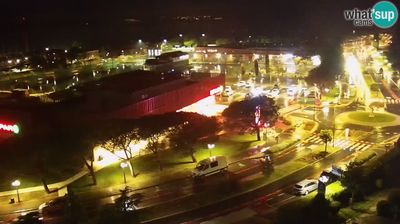
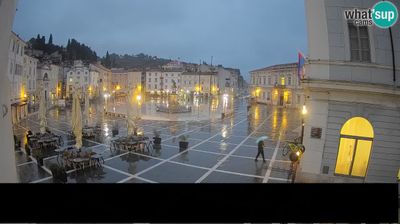

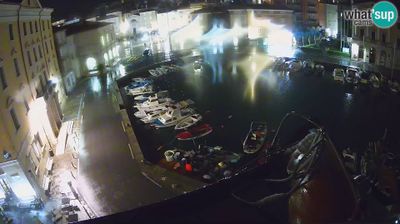

Piran blends Venetian grandeur with the compact rhythm of an Adriatic port town, reflecting its position on Slovenia’s short coast along the Gulf of Trieste. The old town occupies a narrow peninsula, where lanes rise toward the Church of St George and its bell tower above the harbour. Piran belonged to the Venetian Republic from 1283 to 1797, a legacy evident in its facades, arcades and public squares. Tartini Square, named for the Piran-born violinist and composer Giuseppe Tartini, forms the town’s social centre. Salt-making has also long shaped this stretch of coast, including the nearby Sečovlje Salt Pans. Browse other webcams across Slovenia’s Adriatic coast to place this setting in a wider geographic context.
22 webcams
The Adriatic coast defines much of Upravna enota Piran – sheltered bays, seafaring and tourism shape life along Slovenia’s brief shoreline. Its principal town, Piran, occupies a narrow peninsula beside the Bay of Piran, where tightly packed streets and Venetian-era architecture reflect centuries of Adriatic connections. Tartini Square, named for the Piran-born violinist and composer Giuseppe Tartini, forms the town’s civic heart. South of Portorož, the Sečovlje Salt Pans preserve a long salt-making tradition in a wetland setting. This compact area brings together coastal heritage, resorts, marinas and salt pans. Discover other points of interest through webcams located across Upravna enota Piran.
25 webcams
Slovenia occupies a meeting point of the Alps, the Pannonian Plain, the Dinaric mountains and the Adriatic coast in south-central Europe. The Julian Alps rise in the northwest, where Triglav is the country’s highest mountain, while the Soča River is known for its clear turquoise water. Karst terrain has shaped caves such as Postojna Cave and the Škocjan Caves, a UNESCO World Heritage site. Ljubljana combines a riverside old town with works by architect Jože Plečnik; farther east, wine-growing regions and thermal springs add another dimension. Slovenian food reflects Alpine, Mediterranean and Balkan influences. Find related webcams in the surrounding area to build a fuller picture of Slovenia and the northern Adriatic.
783 webcams