 Naples: Castel Nuovo
Tucked along the Bay of Naples, Castel Nuovo is a fortress whose character is shaped by its position on the Tyrrhenian coast. Also called Maschio Angioino, it was begun in 1279 for Charles I of Anjou as a residence for the kings of Naples. Its imposing present profile owes much to an Aragonese reconstruction in the 15th century, when the castle gained its great round towers and the white-marble triumphal arch at the entrance, commissioned for Alfonso of Aragon. The fortress served the Angevin and Aragonese courts, dynasties that made Naples one of the Mediterranean’s major capitals. Standing between the historic centre and harbour, it remains a defining emblem of a city long shaped by seaborne trade.
Generated by AI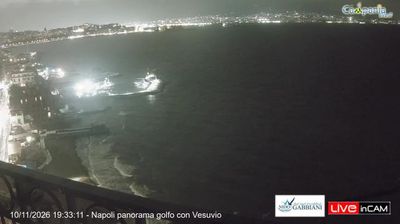






Among Campania’s cities, Naples stands out for its dense historic centre on the Bay of Naples, with Mount Vesuvius rising across the water. Founded by Greeks as Neapolis, it developed into a major Mediterranean port and later served as the capital of the Kingdom of Naples. Its UNESCO-listed historic centre, inscribed in 1995, combines Greek and Roman street plans with churches, palaces and the Naples Cathedral. The National Archaeological Museum holds important finds from Pompeii and Herculaneum, while the waterfront reaches toward Castel dell’Ovo on the former islet of Megaride. Naples is also the birthplace of pizza, whose traditional craft is recognised by UNESCO. See how Naples connects with the Bay of Naples and Campania by browsing webcams nearby.
6 webcams
The terrain of Campania ranges from volcanic lowlands along the Bay of Naples in the west to Apennine uplands in the east, creating a pronounced transition from coast to interior. Naples is the region’s principal city, set beneath Mount Vesuvius, whose 79 CE eruption buried the Roman towns of Pompeii and Herculaneum. South of the bay, the Sorrentine Peninsula and the Amalfi Coast meet the Tyrrhenian Sea, while inland areas such as Irpinia are defined by hills, farmland and smaller historic towns. Campania’s identity is equally expressed through Neapolitan cuisine, especially pizza, and its long connection with the Mediterranean. Find related webcams around Campania to build a fuller picture of this southern Italian region.
72 webcams
Among the countries of southern Europe, Italy stands out for its Mediterranean coastline and cities marked by the legacy of ancient Rome. The Alps form its northern frontier, while the Apennines run down the peninsula and the Po crosses the broad plain of the north. Rome’s Colosseum and Roman Forum recall the ancient empire; Florence is closely associated with the Renaissance, and Venice is built across a lagoon on the Adriatic. Food changes markedly between regions, from olive-oil cooking in the south to rice dishes in the Po Valley. Sicily and Sardinia add distinct island identities to a country whose regions retain strong local character. Explore nearby webcam locations that provide complementary perspectives on Italy’s coasts, cities and mountains.
3.1K webcams