 Moscow: г. Москва, пр-кт. Рязанский, д. 5
Moscow occupies a broad plain in the Moskva River basin of central European Russia. Russia’s capital is structured by ring roads and radial avenues, a pattern extending from the medieval core to dense outer districts east and southeast of the centre. The Moskva River curves through the city, while broad transport corridors link its far-reaching neighbourhoods. At Moscow’s heart, the Kremlin is a fortified complex on Borovitsky Hill and the official residence of the Russian president; it and Red Square are UNESCO World Heritage sites. The metro, opened in 1935, remains essential to travel across this vast urban area. Residential towers, workplaces and major roads give the southeastern quarters a distinctly metropolitan scale.
Generated by AI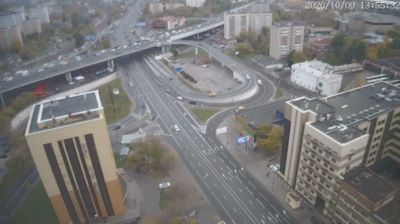
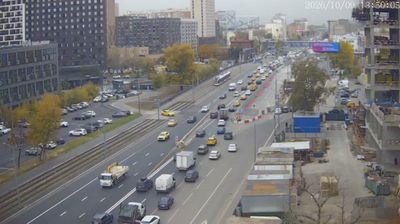

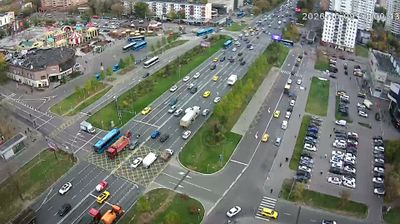



Moscow occupies both banks of the Moskva River in central European Russia. The Kremlin and Red Square, inscribed together on UNESCO’s World Heritage List in 1990, form the historic and political core of the Russian capital. Beside the square stands Saint Basil’s Cathedral, the 16th-century church commissioned by Ivan IV and recognised for its cluster of vividly patterned domes. Moscow’s cultural life extends from the Bolshoi Theatre to its Metro, opened in 1935 and celebrated for stations designed with marble, mosaics and sculpture. Browse other webcams across Moscow and central Russia to place this capital in a wider geographic context.
14 webcams
Moscow occupies a broad inland plain in western Russia. The capital spreads along the Moskva River, whose bends run through districts ranging from the historic centre to vast residential quarters. Red Square and the Kremlin form the best-known core of a city that has been Russia’s political centre for centuries; together they are a UNESCO World Heritage site. Beyond the old centre, Moscow’s immense scale is defined by radial avenues, the circular Garden Ring, major parks and an extensive metro system. Orthodox churches, Soviet-era architecture and contemporary towers give its neighbourhoods a distinctly layered urban identity. Move on to other webcams in the region to compare cityscapes and everyday settings around Moscow.
19 webcams
Russia has served as a major power between Europe and Asia since the 16th century. Its territory crosses eleven time zones, extending from the Baltic coast and the East European Plain over the Ural Mountains to the Pacific. The Volga, Europe’s longest river, runs through a core of historic Russian settlement, while Lake Baikal in Siberia is the world’s deepest lake. Moscow’s Kremlin and Red Square stand at the centre of the capital’s political and architectural heritage; Saint Petersburg’s Hermitage Museum occupies the Winter Palace. Orthodox churches, Russian-language literature, ballet and long-distance rail travel remain familiar reference points in a country of immense regional contrasts. Continue with other webcams from Russia to see how this part of northern Eurasia connects regionally.
466 webcams