 Mascali: Mount Etna
Few places in Sicily have a history as closely tied to volcanic activity as Mount Etna. Europe’s highest active volcano dominates eastern Sicily between the Ionian coast and the island’s interior, its broad flanks built by repeated lava flows. Etna’s eruptions have repeatedly reshaped nearby settlements and farmland, while volcanic soils support vineyards, orchards and other agriculture around Mascali and the wider Catania area. Added to UNESCO’s World Heritage List in 2013, the mountain is embedded in Sicilian tradition: ancient Greek and Roman writers associated it with the forge of Hephaestus, or Vulcan. Its protected terrain extends from cultivated lower slopes to high-altitude lava fields.
Generated by AI


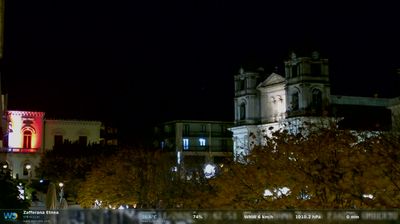



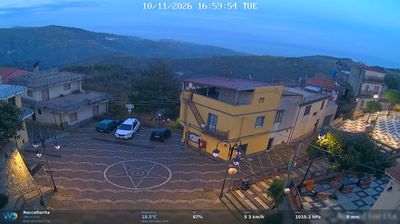

Mascali occupies the lower eastern slopes of Mount Etna in Sicily, between the volcano and the Ionian Sea. It is a working agricultural district, where volcanic soils support citrus groves and vineyards; the coastal hamlet of Fondachello gives the municipality a direct link to the shore. Mascali is also defined by the 1928 eruption of Etna, which destroyed much of the older settlement and prompted its reconstruction. Its location connects the Etnean foothills with the rail and road corridor running along Sicily’s eastern coast. Continue with other webcams from the area to see how this part of eastern Sicily connects regionally.
1 webcam
Sicily stretches from the Strait of Messina to Capo Passero, encompassing volcanic highlands, fertile plains and long Mediterranean coasts. Mount Etna, Europe’s highest active volcano, dominates the east, while the island’s interior is marked by cultivated land and hill towns. Off the northern coast lie the volcanic Aeolian Islands. Palermo’s Arab-Norman monuments reflect centuries of Mediterranean exchange, and Agrigento’s Valley of the Temples preserves major remains of the Greek world. Browse additional webcams from the surrounding area to extend your view of Sicily.
104 webcams
Among the countries of southern Europe, Italy stands out for its Mediterranean coastline and cities marked by the legacy of ancient Rome. The Alps form its northern frontier, while the Apennines run down the peninsula and the Po crosses the broad plain of the north. Rome’s Colosseum and Roman Forum recall the ancient empire; Florence is closely associated with the Renaissance, and Venice is built across a lagoon on the Adriatic. Food changes markedly between regions, from olive-oil cooking in the south to rice dishes in the Po Valley. Sicily and Sardinia add distinct island identities to a country whose regions retain strong local character. Explore nearby webcam locations that provide complementary perspectives on Italy’s coasts, cities and mountains.
2.7K webcams