 Lauscha: Bahnhof - Lauscha
Lauscha straddles the narrow valley of the Lauscha stream in the Thuringian Forest, and its confined setting has concentrated homes, workshops and the railway along the valley floor. The town was founded by glassmakers in 1597 and remains internationally associated with hand-blown glass, particularly Christmas ornaments. Lauscha station stands on the Coburg–Ernstthal am Rennsteig railway, whose curves and gradients reflect the demanding terrain of this central German upland. Houses and small workshops rise above the tracks on wooded slopes, while the Museum für Glaskunst recalls the craft that continues to define Lauscha.
Generated by AI
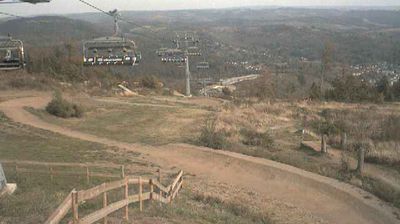


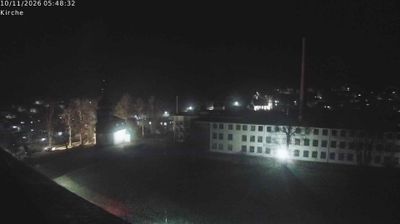




Lauscha sits in the valley of the Lauscha River in Thuringia, Germany, where the wooded ridges of the Thuringian Forest close around a narrow settlement. The town has been associated with glassmaking since its foundation in 1597, when glassworkers established furnaces in this forested valley. Lauscha’s artisans became internationally known for finely made glassware, toys and Christmas ornaments; the local tradition remains central to the town’s identity. The German Museum of Glass Art documents this craft and its changing techniques. Move on to other webcams in Thuringia to compare the forest valleys and upland settings around Lauscha.
2 webcams
Thuringia has served as a cultural crossroads within central Germany since the Middle Ages. Its varied terrain runs from the wooded ridges of the Thuringian Forest to the Saale valley in the east, with the long-distance Rennsteig trail following the forest’s crest. Erfurt, the state capital, preserves a historic centre marked by the cathedral and the Krämerbrücke, a bridge lined with inhabited buildings. Weimar is closely associated with Goethe and Schiller and with the Bauhaus movement, while Wartburg Castle near Eisenach recalls the region’s medieval past. Browse additional webcams from the surrounding area to extend your view of Thuringia.
64 webcams
Germany stretches from the North Sea and Baltic Sea coasts to the Alps on its southern border, encompassing northern plains, river valleys and forested uplands. The Rhine, Danube and Elbe have long connected its regions, while the Black Forest and Bavarian Alps give the south a more dramatic relief. Berlin’s Brandenburg Gate and Museum Island reflect the capital’s role in German history and culture. Cologne Cathedral, a UNESCO World Heritage Site, rises above the Rhine, and the Bauhaus movement, founded in Weimar in 1919, transformed modern design far beyond Germany. Regional cooking, Christmas markets and brewing traditions bring further character to daily life. Browse additional webcams from the surrounding area to extend your view of Germany.
2.1K webcams