 Larissa
 combines the pace of a regional city with the openness of the Thessalian plain in a way that reflects its position beside the Pinios River. One of Greece’s principal inland cities, it is the administrative centre of Thessaly and a longstanding market town for the surrounding agricultural region. The Pinios crosses the urban area, while the level terrain has encouraged development across broad residential districts and transport corridors. In the centre, the First Ancient Theatre of Larissa, built in the 3rd century BC, attests to the importance of ancient Larisa. Its streets, public spaces and riverfront link a working modern city with layers of Greek urban history.
Generated by AI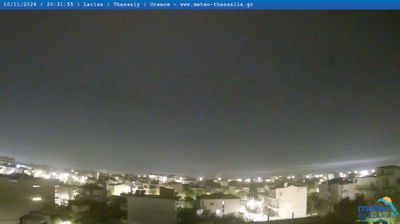


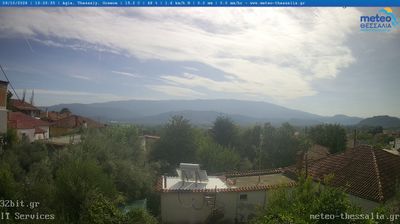

The Pineios River defines the setting of Larissa — its course crosses the broad Thessalian plain that has supported this major inland city for centuries. As the capital of Thessaly, Larissa is an important commercial and administrative centre between mainland Greece’s mountains and Aegean coast. The First Ancient Theatre, built in the 3rd century BCE and now embedded in the city centre, recalls its prominence in ancient Thessaly. Riverfront paths and pedestrian streets give the modern centre a notably urban, everyday rhythm. Find related webcams in the surrounding area to build a fuller picture of Larissa and Thessaly.
1 webcam
Thessaly and Central Greece occupy a broad central stretch of mainland Greece. The Thessalian Plain, long associated with farming, lies between the Pindus Mountains to the west and the Aegean coast to the east, while Central Greece reaches south toward Mount Parnassus and the Gulf of Corinth. In northern Thessaly, the monasteries of Meteora stand atop towering rock pillars and form a UNESCO World Heritage site. Farther south, Delphi, on Parnassus, was one of the most important sanctuaries of the ancient Greek world. Together these areas link cultivated plains, rugged ranges and historic towns. Trace how Thessaly and Central Greece connect across mainland Greece by browsing webcams nearby.
195 webcams
Greece occupies a mountainous peninsula and island-dotted coastline in southeastern Europe. The Aegean Sea shapes its eastern shore, while the Ionian Sea lies to the west; Crete is the country’s largest island. Athens is anchored by the Acropolis, where the Parthenon has stood since the fifth century BCE as a defining monument of classical antiquity. Beyond the capital, the Pindus Mountains run through the mainland, and Mount Olympus is associated in ancient Greek religion with the home of the gods. Greek food traditions centre on olive oil, seafood, cheeses and regional dishes, with long meals remaining an important part of social life. Continue through nearby webcams to explore the islands and mainland regions of Greece.
501 webcams