 Kintai
 lies along the Curonian Lagoon in Klaipėda County, a position that has long connected the settlement with the sheltered waters and wetlands of Lithuania’s western coast. The lagoon belongs to the wider Nemunas Delta region, where low-lying ground, reed beds and open water meet near the Baltic Sea. Kintai developed as a fishing community within the former East Prussian cultural landscape; its historic Lutheran church and the Vydūnas Cultural Centre recall the area’s Lithuanian and German heritage. The broad shore is also used for wind-powered watersports, while the settlement remains a calm counterpoint to the busier resorts of the Curonian Spit. Here, water, reeds and the flat delta plain define the scale more than streets do.
Generated by AI
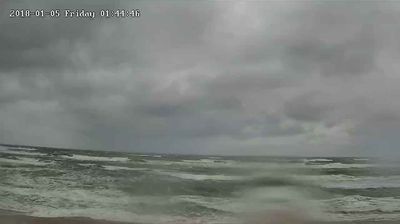

The landscape around Kintai is low-lying and defined by the Curonian Lagoon and the wetlands of the Nemunas Delta, which have shaped both the settlement pattern and local livelihoods. Set on the lagoon’s eastern shore in Klaipėda County, the town belongs to the historic Lithuania Minor region, where Lithuanian and German cultural influences long met. Its Lutheran church recalls the area’s Protestant heritage. Kintai is also associated with the philosopher and writer Vydūnas, who taught at the local school between 1888 and 1892. The lagoon and open delta country give the town a markedly different character from Lithuania’s inland cities. Continue through nearby webcams to explore different parts of the Curonian Lagoon and Klaipėda County.
1 webcam
Built around the Baltic port of Klaipėda, Klaipėda County developed into Lithuania’s principal coastal region. Its shoreline spans the open Baltic Sea and the Curonian Lagoon, separated by the long, dune-shaped Curonian Spit, a UNESCO World Heritage cultural landscape shared with Russia. Klaipėda, historically known as Memel, retains an old town marked by German and Prussian influences, while the Nemunas Delta brings wetlands and broad waterways to the county’s southern edge. Maritime trade, fishing traditions and resort life give this part of Lithuania a distinct coastal identity. Continue with other webcams from the area to see how this part of Lithuania connects regionally.
5 webcams
Lithuania combines Baltic calm with a strongly preserved national identity in a way that reflects its position within the northeastern European Baltic region. The Nemunas, the country’s largest river, crosses broad lowlands before reaching the Curonian Lagoon, while the Curonian Spit forms a long belt of dunes and pine forest along the Baltic Sea. Vilnius is known for its extensive Old Town, recognised by UNESCO, and its streets bring together Gothic, Renaissance, Baroque and neoclassical architecture. Trakai Island Castle, set amid lakes west of the capital, recalls the era of the Grand Duchy of Lithuania. Browse additional webcams from the Baltic region to extend your view of Lithuania.
21 webcams