 Kaunas: Stadiono kamera
Built around the confluence of the Nemunas and Neris, Kaunas grew into Lithuania’s second-largest city and a major centre of learning, business and culture. Its compact centre stretches from the medieval Kaunas Castle and the Old Town to Laisvės Alėja, the long pedestrian thoroughfare linking central districts. Between 1920 and 1940, when Kaunas served as the temporary capital of Lithuania, the city acquired an exceptional body of modernist public and residential architecture. That interwar urban legacy, recognised by UNESCO, gives Kaunas a distinct place in the country’s cultural story. Parks, sports grounds and leafy streets sit alongside denser apartment neighbourhoods beyond the centre.
Generated by AI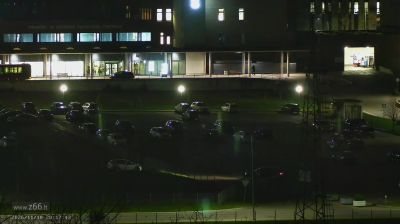



Kaunas sits at the confluence of the Nemunas and Neris rivers in central Lithuania, where the country’s two largest rivers shape a low-lying urban landscape. Lithuania’s second-largest city was the nation’s temporary capital between 1920 and 1940, a period that left an exceptional concentration of interwar modernist buildings. This architecture is recognised by UNESCO in the inscription “Modernist Kaunas: Architecture of Optimism, 1919–1939.” The Old Town, with Kaunas Castle and its surviving Gothic structures, occupies the ground between the two rivers, while Laisvės alėja remains a central pedestrian thoroughfare. Discover how Kaunas connects with central Lithuania by browsing webcams nearby.
2 webcams
Among Lithuania’s regions, Kaunas County stands out for Kaunas, set at the confluence of the Nemunas and Neris rivers. In central Lithuania, the county brings together an urban core, river valleys, farmland and woodland. Kaunas is Lithuania’s second-largest city and served as the country’s temporary capital from 1920 to 1940, an era that produced an exceptional concentration of modernist architecture. “Modernist Kaunas: Architecture of Optimism, 1919–1939” joined the UNESCO World Heritage List in 2023. The Old Town includes Gothic Kaunas Castle and the Town Hall, while the Kaunas Reservoir extends east towards Pažaislis Monastery. Move on to other webcams in the region to compare riverside cityscapes and rural settings around Kaunas County.
4 webcams
Lithuania combines Baltic calm with a strongly preserved national identity in a way that reflects its position within the northeastern European Baltic region. The Nemunas, the country’s largest river, crosses broad lowlands before reaching the Curonian Lagoon, while the Curonian Spit forms a long belt of dunes and pine forest along the Baltic Sea. Vilnius is known for its extensive Old Town, recognised by UNESCO, and its streets bring together Gothic, Renaissance, Baroque and neoclassical architecture. Trakai Island Castle, set amid lakes west of the capital, recalls the era of the Grand Duchy of Lithuania. Browse additional webcams from the Baltic region to extend your view of Lithuania.
20 webcams