 Kamnik
Few places in Upper Carniola have a history as closely tied to its role as a medieval market town as Kamnik. Set beside the Kamniška Bistrica River at the foot of the Kamnik–Savinja Alps, it developed on routes linking the Ljubljana Basin with Alpine valleys. Mali grad, a hilltop medieval complex with a Romanesque chapel, remains one of its defining landmarks. The compact old centre brings together squares, arcades and burgher houses. North of town, the Kamniška Bistrica valley leads into the mountains, while nearby Velika Planina preserves a seasonal herdsmen’s settlement and the tradition of trnič cheese. Its streets retain the scale and fabric of a long-established regional centre.
Generated by AI

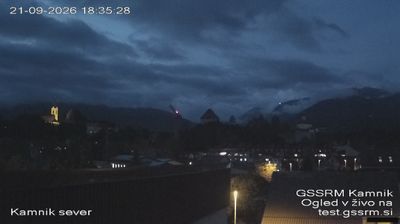

Kamnik is best known in Slovenia for its medieval old town beneath the Kamnik–Savinja Alps. The Kamniška Bistrica runs through the town, while the wooded slopes of Mali grad rise beside the historic centre. On this hill, the Chapel of St Eligius is a surviving Romanesque landmark; its separate bell tower is one of Kamnik’s familiar silhouettes. Streets below retain burgher houses and squares that recall Kamnik’s role as a medieval market town. Zaprice Castle, above the centre, houses the Intermunicipal Museum Kamnik and adds another layer to the town’s local story. Move on to other webcams in central Slovenia to compare landscapes and settings around Kamnik.
10 webcams
Upravna Enota Kamnik extends from the Ljubljana Basin to the Kamnik–Savinja Alps, encompassing cultivated lowlands, a medieval town and steep Alpine valleys. The Kamniška Bistrica flows through Kamnik, whose compact old centre preserves the Mali grad chapel and the ruins of its former castle. North of town, the valley narrows towards mountain country, while Velika Planina is known for its high pasture and distinctive herdsmen’s huts. At Volčji Potok, the Arboretum provides a contrasting formal landscape and is especially associated with spring flowering. Continue through nearby webcams to explore different parts of the Kamnik area.
12 webcams
Slovenia occupies a meeting point of the Alps, the Pannonian Plain, the Dinaric mountains and the Adriatic coast in south-central Europe. The Julian Alps rise in the northwest, where Triglav is the country’s highest mountain, while the Soča River is known for its clear turquoise water. Karst terrain has shaped caves such as Postojna Cave and the Škocjan Caves, a UNESCO World Heritage site. Ljubljana combines a riverside old town with works by architect Jože Plečnik; farther east, wine-growing regions and thermal springs add another dimension. Slovenian food reflects Alpine, Mediterranean and Balkan influences. Find related webcams in the surrounding area to build a fuller picture of Slovenia and the northern Adriatic.
782 webcams