 Helsinki: Tie 101 - Pirkkola - Kehä I Länteen
Tucked along the Gulf of Finland, Helsinki is a city whose character is shaped by its Baltic shoreline, islands and wide stretches of urban woodland. Finland’s capital began as a trading town founded by King Gustav I in 1550 at the mouth of the Vantaa River, then grew into the country’s political and cultural centre. Its compact core combines neoclassical architecture around Senate Square with modernist public buildings, while the sea fortress of Suomenlinna, begun in 1748, occupies a group of offshore islands and is a UNESCO World Heritage site. Pirkola sits in northern Helsinki, where Kehä I, Finland’s National Road 101, forms an important cross-city transport corridor amid residential districts and green areas.
Generated by AI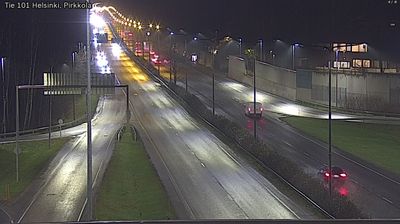

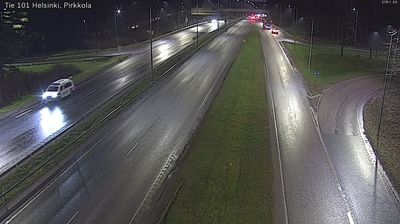

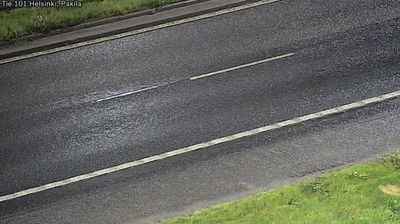
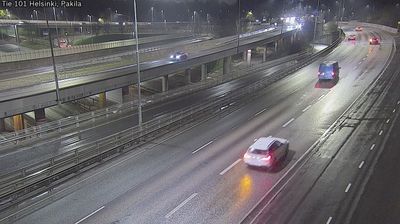
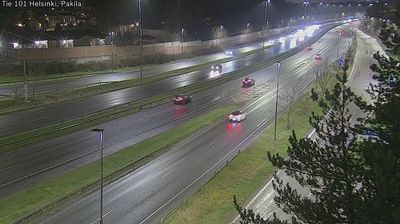
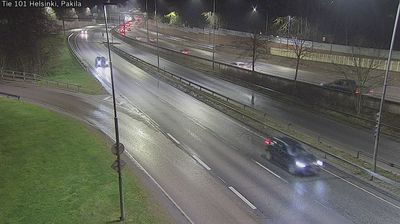

Helsinki sits on the Gulf of Finland in southern Finland, where a low peninsula and a scatter of Baltic islands shape the capital’s waterfront. Founded in 1550, the city became Finland’s capital in 1812 and developed a distinctive neoclassical centre around Senate Square. Helsinki Cathedral presides over that square, while the harbour-side Market Square connects central streets with ferries and maritime life. Offshore, the island fortress of Suomenlinna was begun in 1748 and is now a UNESCO World Heritage Site. Trams, public saunas and an active design culture give the compact centre a strongly Finnish rhythm. Browse additional webcams from the surrounding area to extend your view of Helsinki and southern Finland.
31 webcams
The terrain of Uusimaa ranges from a low, island-dotted coast in the south to wooded uplands and lake country in the north, binding Finland’s capital region to the Gulf of Finland. Helsinki, the national capital, is its urban centre, while the coast extends through the municipalities of Espoo and Porvoo. Suomenlinna, the sea fortress off Helsinki and a UNESCO World Heritage Site, recalls Sweden’s 18th-century rule; the medieval Porvoo Cathedral and old town add another historic strand. Inland, Nuuksio National Park protects a mosaic of forest, lakes and rocky terrain close to the metropolitan area. Explore additional nearby webcams to see how Uusimaa connects with the Gulf of Finland and southern Finland.
203 webcams
The terrain of Finland ranges from low coastal plains along the Gulf of Bothnia to fells in Lapland, creating a country of forests, lakes and long northern distances. More than 180,000 lakes shape everyday life, while the Lakeland region is threaded with waterways and islands. Helsinki, on the Gulf of Finland, combines neoclassical landmarks around Senate Square with contemporary Finnish design. Farther north, the Sámi are Finland’s only recognised Indigenous people, and their culture remains closely connected to the Arctic region. In winter, snow and ice transform the north; in summer, long daylight extends outdoor life well into the evening. Continue through nearby webcams to explore different parts of Finland.
1.7K webcams