 Haan
Haan straddles the Düssel in North Rhine-Westphalia, and its position between Düsseldorf and Wuppertal has tied it to the wider Rhine-Ruhr urban region. The town belongs to the district of Mettmann and stands on the western edge of the Bergisches Land, where the terrain begins to rise away from the Rhine plain. Haan is known as the “Garden City”, a designation reflected in its residential streets and green spaces. Its older centre retains dark slate-clad buildings associated with traditional Bergisches Land architecture. The district of Gruiten adds a more rural character, with limestone ground shaped by former quarrying. Haan is a quieter urban stop within one of Germany’s most densely settled areas.
Generated by AI


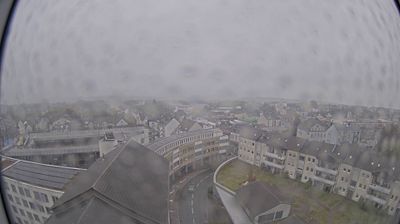
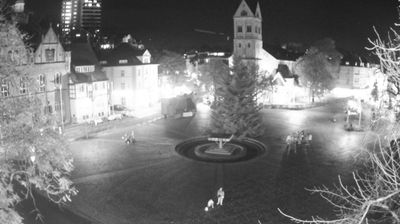

Haan has served as a settlement in the Bergisches Land since the late Middle Ages. In North Rhine-Westphalia’s Kreis Mettmann, it stands between Düsseldorf and Wuppertal, on the transition from the Rhineland’s lowlands to the rolling country of the Bergisches Land. The Düssel runs through the municipal area, while woodland and agricultural land remain close to its built-up centre. Haan is often called the Gartenstadt, a title reflected in its leafy residential streets and parks. The incorporated district of Gruiten has an old centre associated with the region’s limestone landscape, and the Neandertal is nearby. Explore nearby webcam locations that provide complementary perspectives on Haan, the Düssel valley and the Bergisches Land.
1 webcam
Built around the Rhine trade corridor and the Ruhr coal-and-steel belt, North Rhine-Westphalia grew into Germany’s most populous state. The Rhine crosses its western side, linking Cologne, Düsseldorf and Bonn, while the Ruhr became one of Europe’s defining industrial regions. Dortmund, near these coordinates, reflects that legacy alongside a major football and brewing tradition. Cologne Cathedral, a UNESCO World Heritage site, remains the state’s best-known monument, and Essen’s Zollverein Coal Mine Industrial Complex records the scale of its mining past. Forested uplands in the Sauerland and Teutoburg Forest broaden a region often associated only with cities and factories. Explore additional webcams nearby to better understand how North Rhine-Westphalia connects the Rhine, the Ruhr and its surrounding uplands.
273 webcams
Germany stretches from the North Sea and Baltic Sea coasts to the Alps on its southern border, encompassing northern plains, river valleys and forested uplands. The Rhine, Danube and Elbe have long connected its regions, while the Black Forest and Bavarian Alps give the south a more dramatic relief. Berlin’s Brandenburg Gate and Museum Island reflect the capital’s role in German history and culture. Cologne Cathedral, a UNESCO World Heritage Site, rises above the Rhine, and the Bauhaus movement, founded in Weimar in 1919, transformed modern design far beyond Germany. Regional cooking, Christmas markets and brewing traditions bring further character to daily life. Browse additional webcams from the surrounding area to extend your view of Germany.
2.8K webcams