 Swidnica: Dolní Morava - U Slona

Tucked between the Silesian Lowland and the Sudetes, Świdnica is a place whose character is shaped by its position on the Bystrzyca River in south-western Poland. It developed as an important Silesian town, with a medieval street pattern still converging on Rynek, its central market square. The Church of Peace, built in 1656–57 after the Peace of Westphalia, is the city’s defining monument: a vast Lutheran timber-framed church erected under strict limits on materials and location. Together with the Church of Peace in Jawor, it forms a UNESCO World Heritage site. Świdnica’s centre also preserves the Gothic town hall tower, churches and historic burgher houses, while the Sudetes define the wider regional setting.
Generated by AI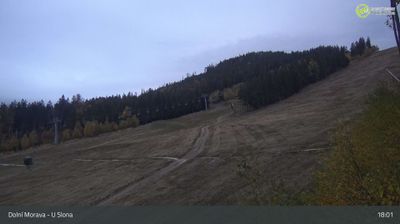





Świdnica straddles the Bystrzyca River in Lower Silesia, and its river-valley setting supported the growth of an important medieval ducal town. Once the seat of the Duchy of Świdnica, it retains a compact historic centre shaped by Gothic, Renaissance and Baroque rebuilding. Its defining monument is the Church of Peace, a UNESCO World Heritage site erected in 1656–57 under restrictions that required a timber-frame construction; its vast interior is among Europe’s most remarkable Protestant spaces. The Gothic Cathedral of St Stanislaus and St Wenceslaus and the Market Square add to a cityscape reflecting centuries of Silesian rule. Find related webcams in Lower Silesia to build a fuller picture of Świdnica and its surroundings.
1 webcam
Among the regions of Poland, Lower Silesian Voivodeship stands out for the meeting of the Sudetes, the Oder valley and historic Wrocław. Its southern edge reaches the Karkonosze range, where Śnieżka rises as the highest peak of the Sudetes, while broad lowlands and river corridors shape the north. Wrocław is the regional centre, known for its Market Square, the cathedral district of Ostrów Tumski and the UNESCO-listed Centennial Hall. Further west, Książ Castle near Wałbrzych recalls the area’s long Silesian past. Browse additional webcams around the region to extend your view of Lower Silesia.
73 webcams
Poland stretches from the Baltic Sea coast in the north to the Carpathian Mountains along its southern frontier, encompassing broad lowlands, lake districts and upland ranges. The Vistula, the country’s longest river, links Kraków and Warsaw before reaching the Baltic near Gdańsk, while the Masurian Lake District is defined by a dense network of lakes. Kraków’s historic centre, including Wawel Castle, recalls Poland’s former royal capital; Warsaw’s rebuilt Old Town speaks to the city’s recovery after the Second World War. The Białowieża Forest preserves one of Europe’s last primeval lowland forests and is home to European bison. Follow how Poland’s regions relate to one another by browsing webcams across the country.
715 webcams