 Bad Waltersdorf: VK_A02_128,340-F2-FL
The Eastern Styrian Hills define the setting of Bad Waltersdorf — cultivated fields, scattered farms and wooded rises give this part of Styria its softly rolling character. The town stands in southeastern Austria near the A2 Süd Autobahn, a major route linking Vienna and Graz. Bad Waltersdorf belongs to Styria’s thermal region, and Heiltherme Bad Waltersdorf has made bathing and wellness central to its modern identity. It remains a compact spa town rather than an urban centre, with rural settlement patterns extending through the surrounding hills. Agriculture, thermal tourism and strong road connections all shape daily life in this corner of Austria.
Generated by AI
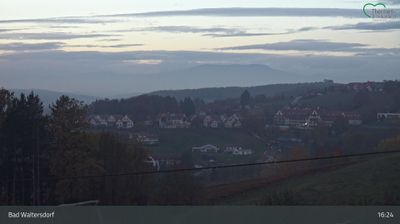
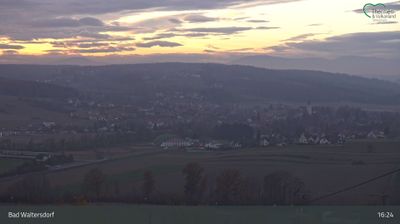
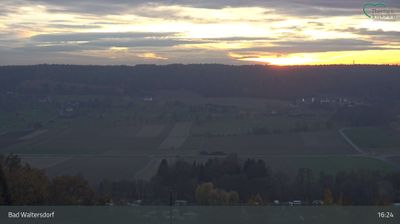





Bad Waltersdorf has served as a thermal spa resort in eastern Styria since the late 20th century. Set among the rolling hills of the Safen valley, the town forms part of Austria’s Thermen- und Vulkanland Steiermark, a region shaped by warm mineral water and small-scale farming. Heiltherme Bad Waltersdorf is central to local life, while the surrounding countryside is associated with orchards, vineyards and farm produce typical of eastern Styria. This is a quieter side of the province, distinct from the Alpine terrain farther west. Discover how Bad Waltersdorf connects with Styria’s thermal country by browsing webcams nearby.
5 webcams
The terrain of Styria ranges from Alpine ridges in the north and west to vine-covered hills in the southeast, giving Austria’s second-largest province a distinctly varied character. The Mur is its principal river, flowing through Graz, the provincial capital and largest city. Graz’s Old Town and Schloss Eggenberg are jointly inscribed on UNESCO’s World Heritage List, linking Renaissance and Baroque architecture to the region’s urban identity. Southern Styria is known for vineyards and pumpkin-seed oil, while forests and pastureland shape much of the interior. Discover how Styria connects with the wider Austrian landscape by browsing webcams nearby.
415 webcams
Austria stretches from the Bohemian Massif along its northern edge to the Carnic Alps on the Italian border, encompassing high Alpine ranges and the Danube lowlands. The Danube links cities including Linz and Vienna, while the Grossglockner, at 3,798 metres, is the country’s highest mountain. Vienna developed for centuries as the seat of the Habsburg court, leaving imperial architecture around the Hofburg and Schönbrunn Palace. Salzburg is closely associated with Wolfgang Amadeus Mozart, who was born there in 1756. Alpine Tyrol, wine-growing areas east of Vienna and the lakes of Salzkammergut add markedly different regional identities. Browse other webcams across Austria to place this setting in a wider geographic context.
3.1K webcams