 Bad Salzuflen: Kurparkhaupteingang, Kurhaus

Bad Salzuflen straddles the Salze in the Lippe region of North Rhine-Westphalia, and its saline springs first supported salt production before shaping the town’s spa identity. The Kurpark is the landscaped centre of the resort quarter, with formal paths, mature trees and buildings devoted to rest and treatment. Among its defining features are graduation towers, timber structures where brine runs over blackthorn branches to concentrate the salt. The nearby centre retains gabled half-timbered houses, linking the town’s Lippe heritage with a long-established health-resort role. The wooded ridges of the Teutoburg Forest rise across the wider region.
Generated by AI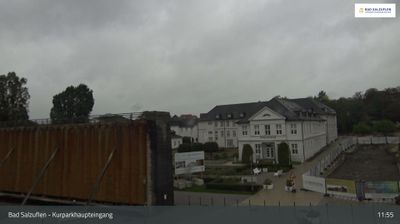
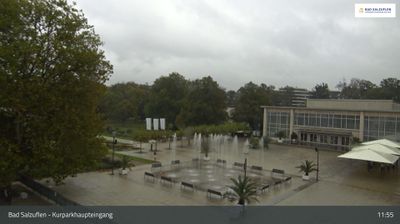
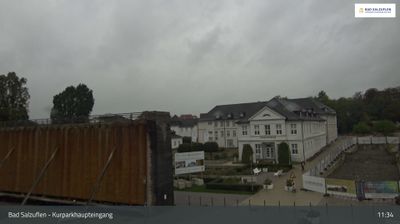
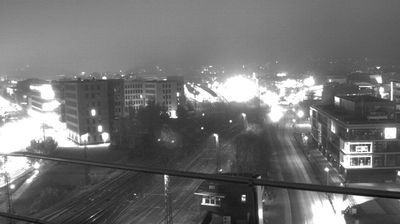



Built around salt springs, Bad Salzuflen developed into a spa town in the Lippe district of North Rhine-Westphalia. The River Salze runs through the town, which lies on the northeastern edge of the Teutoburg Forest. Salt extraction shaped local life for centuries, and its legacy remains tangible in the Kurpark’s graduation towers, where brine trickles over blackthorn branches to create a saline microclimate. The historic centre retains timber-framed houses, while the surrounding East Westphalian landscape extends toward forested ridges and open farmland. Find related webcams across the surrounding area to build a fuller picture of Lippe and East Westphalia.
2 webcams
Built around the Rhine trade corridor and the Ruhr coal-and-steel belt, North Rhine-Westphalia grew into Germany’s most populous state. The Rhine crosses its western side, linking Cologne, Düsseldorf and Bonn, while the Ruhr became one of Europe’s defining industrial regions. Dortmund, near these coordinates, reflects that legacy alongside a major football and brewing tradition. Cologne Cathedral, a UNESCO World Heritage site, remains the state’s best-known monument, and Essen’s Zollverein Coal Mine Industrial Complex records the scale of its mining past. Forested uplands in the Sauerland and Teutoburg Forest broaden a region often associated only with cities and factories. Explore additional webcams nearby to better understand how North Rhine-Westphalia connects the Rhine, the Ruhr and its surrounding uplands.
273 webcams
Germany stretches from the North Sea and Baltic Sea coasts to the Alps on its southern border, encompassing northern plains, river valleys and forested uplands. The Rhine, Danube and Elbe have long connected its regions, while the Black Forest and Bavarian Alps give the south a more dramatic relief. Berlin’s Brandenburg Gate and Museum Island reflect the capital’s role in German history and culture. Cologne Cathedral, a UNESCO World Heritage Site, rises above the Rhine, and the Bauhaus movement, founded in Weimar in 1919, transformed modern design far beyond Germany. Regional cooking, Christmas markets and brewing traditions bring further character to daily life. Browse additional webcams from the surrounding area to extend your view of Germany.
2.8K webcams