 Seeg: Schwaltenweiher
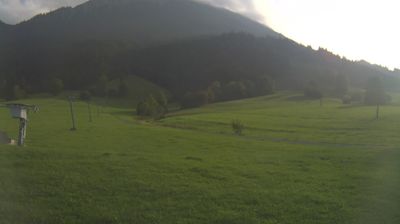
Few places in Bavaria have a history as closely tied to Allgäu dairy farming as Seeg. The municipality occupies rolling country in the Allgäu foothills, where Schwaltenweiher brings open water into a setting of grassland, farms and stands of trees; the Alps form the wider southern skyline. The lake belongs to the area's recreational landscape, while the surrounding fields reflect the cattle farming that has long shaped this corner of southern Bavaria. Local identity is also expressed through Allgäu cheese-making traditions and Seeg's parish church of St Ulrich, whose Baroque character recalls the region's Catholic heritage. Seeg is a compact rural community defined by lake shore, pasture and proximity to the mountains.
Generated by AI

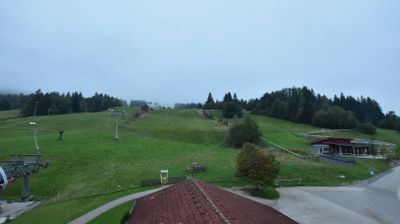



Seeg occupies a rolling upland in Bavaria’s Allgäu, north of the Allgäu Alps. This Ostallgäu municipality is shaped by dairy farming: grassland, working farms and scattered hamlets define the country around its compact centre. The parish church of St Ulrich, a late-Baroque building with an ornate Rococo interior, is Seeg’s principal architectural landmark and a reminder of the region’s Catholic artistic traditions. Trails and quiet lanes lead out across the open terrain, while rail connections place the settlement on the route toward Füssen and the Alpine borderlands. Continue through nearby webcams to explore different parts of the Allgäu.
2 webcams
Built around the early medieval Duchy of Bavaria, Bavaria grew into Germany’s largest federal state. The Danube crosses its broad centre, while the Bavarian Alps form its southern edge and include the Zugspitze, Germany’s highest mountain. Munich is the state capital and the home of Oktoberfest, a festival rooted in an 1810 royal wedding. Beyond the metropolis, Franconia’s vineyards, Swabian towns and Alpine resorts reveal how varied this part of Germany can be. Browse additional webcams from the surrounding area to extend your view of Bavaria.
862 webcams
Germany stretches from the North Sea and Baltic Sea coasts to the Alps on its southern border, encompassing northern plains, river valleys and forested uplands. The Rhine, Danube and Elbe have long connected its regions, while the Black Forest and Bavarian Alps give the south a more dramatic relief. Berlin’s Brandenburg Gate and Museum Island reflect the capital’s role in German history and culture. Cologne Cathedral, a UNESCO World Heritage Site, rises above the Rhine, and the Bauhaus movement, founded in Weimar in 1919, transformed modern design far beyond Germany. Regional cooking, Christmas markets and brewing traditions bring further character to daily life. Browse additional webcams from the surrounding area to extend your view of Germany.
2.8K webcams