 Dinant
 occupies a narrow valley on the Meuse in Wallonia. Its compact centre runs between the river and a sheer limestone escarpment crowned by the Citadel of Dinant, a fortress rebuilt under Dutch rule in the early 19th century. At the foot of the rock stands the Collegiate Church of Notre-Dame, whose bulbous bell tower is one of the town’s defining forms. Dinant is the birthplace of Adolphe Sax, inventor of the saxophone, and his name remains part of the town’s identity. Riverside façades, quays and bridges make the Meuse the organizing axis of daily life, while the surrounding cliffs and wooded slopes distinguish this stretch of valley from Belgium’s flatter interior.
Generated by AI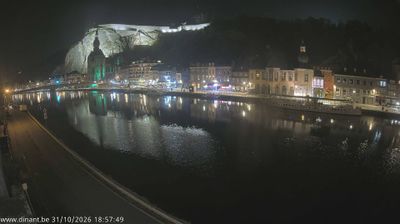
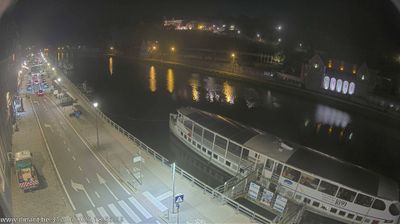
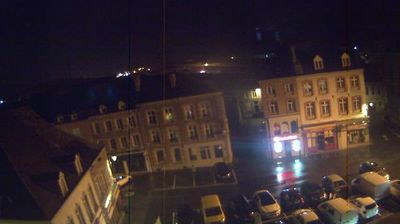




Among Wallonia’s cities, Dinant is distinguished by its striking position between the River Meuse and a limestone cliff crowned by its citadel. The Collegiate Church of Notre-Dame, recognisable by its bulbous bell tower, stands beside the water below the fortress. Dinant is also the birthplace of Adolphe Sax, the 19th-century inventor of the saxophone, and references to his instrument appear throughout the town. South of Namur, it forms part of the Meuse valley, where roads, rail lines and promenades follow a narrow corridor between rock and river. Move on to other webcams in Wallonia to compare river valleys and town settings around Dinant.
3 webcams
Among Belgium’s regions, Wallonia stands out for its French-speaking identity and the Meuse and Sambre valleys that helped shape the country’s industrial age. The Meuse runs through a chain of historic towns, including Namur, where the Sambre joins it beneath the city’s citadel, and Dinant, the birthplace of saxophone inventor Adolphe Sax. South and east, the terrain rises into the Ardennes, with forests, river valleys and smaller settlements replacing the denser urban belt. Wallonia’s towns still reflect long traditions of mining, metalworking and river trade, while abbey brewing remains part of the regional culture. Browse additional webcams from the surrounding area to extend your view of Wallonia.
47 webcams
Belgium occupies a low-lying North Sea coastline and river plain in northwestern Europe. Dutch-speaking Flanders lies largely to the north, while French-speaking Wallonia reaches south towards the wooded Ardennes; Brussels is officially bilingual. The Scheldt and Meuse have long connected Belgian cities with the North Sea and continental Europe. Brussels’ Grand-Place, framed by ornate guildhalls and the Town Hall, is a UNESCO World Heritage site. Medieval Bruges retains canals and merchant architecture, while Antwerp remains a major port on the Scheldt. Belgian beer culture is recognised by UNESCO as intangible cultural heritage. See how Belgium connects with the North Sea coast and neighbouring regions by browsing webcams nearby.
99 webcams