 Monchegorsk: Ploshchad'
The Monchetundra range defines the setting of Monchegorsk — its rounded, forested fells give this industrial city on the Kola Peninsula a clear northern frame. Lake Imandra, one of Murmansk Oblast’s largest lakes, lies close to the city. Monchegorsk developed in the 1930s around copper-nickel mining and smelting, an industry that remains central to its identity. Ploshchad', the central-square district, reflects the broad streets, civic buildings and apartment blocks associated with Soviet urban planning. This is a compact urban centre surrounded by taiga and low mountain terrain, with a form shaped as much by industry as by its far-northern setting.
Generated by AI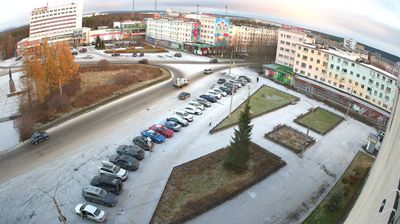

Among the cities of Murmansk Oblast, Monchegorsk stands out for its position between Lake Imandra and the Monchetundra Mountains on the Kola Peninsula. Founded in 1937 amid the development of nearby copper-nickel deposits, it grew as a centre of the region’s metallurgical industry; the Severonickel works remain closely associated with the city. Arctic latitude gives the place a strongly seasonal rhythm, from the summer light of the far north to the winter period of polar night. Lake Imandra, one of the Kola Peninsula’s largest lakes, anchors the broader setting, while low mountain terrain begins close to town. Browse additional webcams from the surrounding area to extend your view of the Kola Peninsula.
2 webcams
Among the regions of Russia, Murmansk Oblast stands out for its Arctic position across the Kola Peninsula, between the Barents and White seas. Its northern coast is shaped by the relatively mild waters of the Barents Sea, while inland terrain shifts from tundra and forest to the Khibiny Mountains and Lake Imandra. Murmansk, founded in 1916, developed as a major northern port and remains the oblast’s principal city. The area is also part of Sápmi, the wider traditional homeland of the Sámi people. Mining and fishing are central to its economy and identity, alongside scientific and maritime activity. View additional webcams nearby to better understand how Murmansk Oblast relates to its Arctic seas and the rest of the Kola Peninsula.
6 webcams
Russia has served as a major power between Europe and Asia since the 16th century. Its territory crosses eleven time zones, extending from the Baltic coast and the East European Plain over the Ural Mountains to the Pacific. The Volga, Europe’s longest river, runs through a core of historic Russian settlement, while Lake Baikal in Siberia is the world’s deepest lake. Moscow’s Kremlin and Red Square stand at the centre of the capital’s political and architectural heritage; Saint Petersburg’s Hermitage Museum occupies the Winter Palace. Orthodox churches, Russian-language literature, ballet and long-distance rail travel remain familiar reference points in a country of immense regional contrasts. Continue with other webcams from Russia to see how this part of northern Eurasia connects regionally.
457 webcams