 Cluny: La Tour Ronde
Cluny is best known within France for Cluny Abbey, founded in 910. In the Grosne valley, the town grew around a Benedictine house whose church was, for centuries, the largest in Western Christendom. Much of the medieval abbey was dismantled after the French Revolution, yet major surviving sections still convey its former scale. La Tour Ronde contributes to the historic fabric of central Cluny, where stone buildings, former monastic spaces and broad public grounds sit below the wooded hills of southern Burgundy. The abbey’s reforming influence extended through a network of dependent priories across Europe, making this small town a landmark in medieval religious history.
Generated by AI

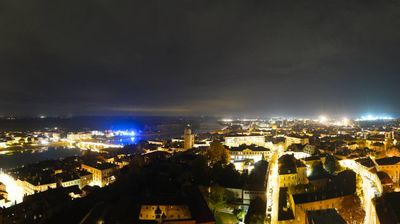






Few cities in Bourgogne–Franche-Comté have a history as closely tied to Benedictine monasticism as Cluny. Founded in 910, Cluny Abbey became the centre of a far-reaching monastic network and a major force in medieval western Christianity. The surviving transept of its great Romanesque church, much of which was dismantled after the French Revolution, still signals the scale of the former complex. The town lies beside the Grosne in the gently rolling countryside of southern Burgundy, where Romanesque churches and vineyard country shape local routes. Move on to other webcams in Bourgogne–Franche-Comté to compare landscapes and settings around Cluny and southern Burgundy.
1 webcam
Bourgogne–Franche-Comté is best known within France for Burgundy’s climats, a UNESCO-listed mosaic of vineyard parcels and winegrowing settlements. The region joins the historic Burgundy wine country around Dijon and Beaune with Franche-Comté, where the Jura Mountains run along the Swiss border. The Saône crosses its western lowlands, while the Doubs shapes valleys farther east. Dijon’s Palace of the Dukes and Estates of Burgundy recalls the capital’s ducal past; in the Jura, Comté cheese is made under a protected designation of origin. Vineyards, stone towns, forests and mountain pastures give this large eastern region a distinctly varied identity. Discover other points of interest through webcams located across Bourgogne–Franche-Comté.
90 webcams
The Atlantic and Mediterranean coastlines, together with the Alps, Pyrenees and broad river basins, define much of France — they support maritime trade, farming, wine regions and travel throughout the year. The Seine runs through Paris, where the Eiffel Tower and the Louvre are among Europe’s most recognised landmarks. The Loire Valley is known for Renaissance châteaux, while Mont-Saint-Michel rises from a tidal bay in Normandy. Regional food traditions are equally distinctive, from Breton seafood to Provençal cooking, with bread, cheese and wine central to everyday life. France’s global cultural influence is evident in its language, literature, fashion and cinema. View additional webcams nearby to better understand how France’s coasts, plains and mountain borders relate to their surroundings.
2.2K webcams