 Saint Augustine
St. Augustine has served as a colonial port and military outpost on Florida’s Atlantic coast since 1565. Founded by Spaniards more than four decades before Jamestown, it is widely regarded as the oldest continuously inhabited settlement of European origin in the United States. Its historic quarter gathers around Matanzas Bay, where the coquina walls of Castillo de San Marcos recall the city’s strategic place in Spanish Florida. The city also preserves 19th-century Flagler College, formerly the Ponce de Leon Hotel, a Gilded Age landmark. Beyond the old streets, Interstate 95 forms a major north–south route through the wider St. Augustine area, linking this historic coast with the rest of Florida.
Generated by AI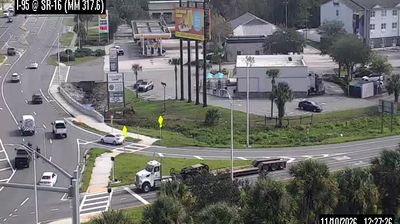









Built around a Spanish colonial settlement on Matanzas Bay, St. Augustine grew into the oldest continuously occupied European-established city in the United States. Founded in 1565, it preserves an unusually concentrated colonial core beside Florida’s Atlantic coast. The coquina walls of Castillo de San Marcos, begun in 1672 by the Spanish, recall the long contest for control of the peninsula; it is the oldest masonry fort in the contiguous United States. St. George Street runs through the historic district, while Flagler College occupies the former Ponce de Leon Hotel, completed in 1888. Explore further points of interest through webcams across St. Augustine and Florida’s Historic Coast.
8 webcams
Florida occupies a low-lying peninsula in the southeastern United States, bordered by the Atlantic Ocean to the east and the Gulf of Mexico to the west. Lake Okeechobee lies near its centre, and water from this basin historically flowed south through the Everglades, a vast subtropical wetland protected in part by Everglades National Park. The Florida Keys extend southwest from the mainland, while long sandy coasts and inland freshwater systems shape everyday life across the state. St. Augustine, founded by Spain in 1565, is widely recognised as the oldest continuously inhabited European-established settlement in the United States. Explore additional webcams nearby to understand how Florida connects with the Atlantic, the Gulf, and the Caribbean.
4.5K webcams
The Atlantic, Pacific and Gulf coasts define much of the United States — their ports, fisheries and trade routes have long tied the country’s economy to the wider world. Between them, the Rocky Mountains, Great Plains and Mississippi River basin form sharply different regions, from high western ranges to broad agricultural heartlands. Cities carry much of the national story: New York’s Statue of Liberty, a gift from France dedicated in 1886, remains an enduring symbol, while Washington, DC concentrates major federal institutions. Indigenous nations have shaped these lands for millennia, and their living cultures remain essential to the country’s identity. Find related webcams in the surrounding areas to build a fuller picture of the United States.
32K webcams