 Varaždin
The Drava River defines the setting of Trnovec Bartolovečki — its broad lowland plain gives this Croatian municipality a settled, agricultural character beneath the distant Kalnik hills. Red-tiled roofs and detached homes stand among cultivated plots in a landscape long shaped by the river basin. The settlement belongs to Varaždin County in northern Croatia, close to the city of Varaždin, whose compact historic centre is known for Baroque streets and palaces. That urban heritage contrasts with the quieter residential pattern here, where open fields remain an important part of the local setting. Kalnik, a wooded hill range farther south, forms a familiar horizon across this section of the Drava basin.
Generated by AI
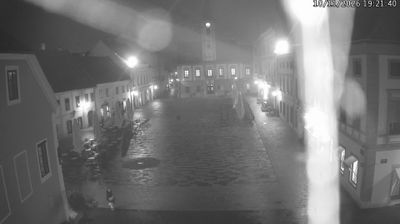
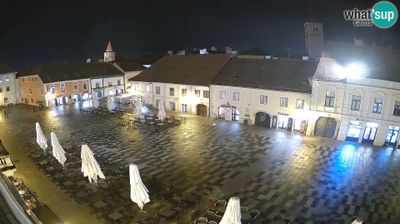





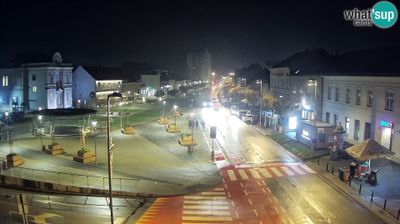

The low, fertile landscape around Varaždin lies on the Drava River plain, which has shaped both the urban form and local economy. In northern Croatia, the city developed as a trading and administrative centre and served as the Croatian capital from 1756 to 1776. Its compact historic core is marked by Baroque streets, palaces and churches, while the moated Old Town fortress, now home to the Varaždin City Museum, recalls its defensive past. Varaždin’s cemetery is renowned for its formally arranged yew hedges. Each year, Špancirfest fills the centre with street performance, music and art. Browse additional webcams from the surrounding area to extend your view of Varaždin County.
1 webcam
Varaždin County stretches from the Drava River on Croatia’s northern border to the slopes of Ivanščica, encompassing fertile lowlands and the rolling hills of Hrvatsko zagorje. Its administrative centre, Varaždin, is known for a compact Baroque core and the Stari Grad fortress, which houses the Varaždin City Museum. The city’s Varaždin Baroque Evenings concert festival reflects a long musical tradition, while Lepoglava is associated with Croatian lace-making. Along the Drava, floodplain habitats and cultivated fields give the county a distinctly northern Croatian character. Place Varaždin County in its wider setting by browsing webcams around the Drava valley and northern Croatia.
8 webcams
Croatia occupies a long Adriatic coastline in southeastern Europe. Its shore is broken into islands and sheltered coves, while the Dinaric Alps rise inland and the Danube forms part of its eastern border. Dubrovnik’s fortified old city faces the sea, and Split grew around Diocletian’s Palace, a Roman complex begun in the early fourth century. Inland, Plitvice Lakes National Park is known for terraced lakes linked by waterfalls and has been a UNESCO World Heritage Site since 1979. Istrian olive groves, Zagreb and Slavonia’s vineyards reveal distinct regional identities. Explore nearby webcam locations that provide complementary perspectives on the Adriatic coast and Croatia’s interior.
381 webcams