 Chita
Chita has served as an administrative centre of Transbaikalia since 1851. The city stands where the Chita River meets the Ingoda, amid the forested hills of Zabaykalsky Krai in eastern Siberia. Its growth accelerated with the Trans-Siberian Railway, which made it an important rail junction between Siberia and the Russian Far East. Chita is also associated with the Decembrists, participants in the failed 1825 uprising who were sent into Siberian exile; their legacy is preserved at the Decembrists’ Museum. Today, wide avenues, Soviet-era districts and newer housing extend across a broad river valley, while the surrounding ridges keep the city closely tied to the Transbaikal landscape.
Generated by AI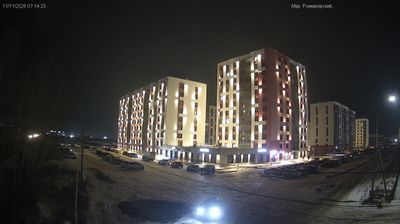

Chita is best known in Zabaykalsky Krai for serving as its administrative capital. The city stands where the Chita River meets the Ingoda, amid the broad valleys and wooded uplands of eastern Siberia. Chita is an important stop on the Trans-Siberian Railway, a role that has long connected it with Russia’s Pacific-facing regions and the national rail network. Its links to the Decembrists are preserved at the Decembrists’ Church Museum, housed in the former Mikhailo-Arkhangelsk Church. Continue with other webcams from the area to see how this part of Zabaykalsky Krai connects across eastern Siberia.
1 webcam
Zabaykalsky Krai’s terrain runs from forested mountain ranges in the west to open steppe near the Mongolian border, creating a distinctly continental region of wide seasonal contrasts. East of Lake Baikal, it forms part of historic Transbaikalia, where the Ingoda and Onon rivers meet to form the Shilka; together with the Argun, these waterways feed the Amur basin. Chita, the regional capital, is an important stop on the Trans-Siberian Railway and the main urban centre of this vast territory. Russian, Buryat and other Siberian traditions meet here, particularly in the former Agin-Buryat area. Explore other webcams in the region to compare mountain, steppe and river settings around Zabaykalsky Krai.
1 webcam
Russia has served as a major power between Europe and Asia since the 16th century. Its territory crosses eleven time zones, extending from the Baltic coast and the East European Plain over the Ural Mountains to the Pacific. The Volga, Europe’s longest river, runs through a core of historic Russian settlement, while Lake Baikal in Siberia is the world’s deepest lake. Moscow’s Kremlin and Red Square stand at the centre of the capital’s political and architectural heritage; Saint Petersburg’s Hermitage Museum occupies the Winter Palace. Orthodox churches, Russian-language literature, ballet and long-distance rail travel remain familiar reference points in a country of immense regional contrasts. Continue with other webcams from Russia to see how this part of northern Eurasia connects regionally.
460 webcams