 Dubrovnik: Brsalje - Park Pile - Pile Bastion - Ulica Iza Grada
The landscape around Dubrovnik is a steep limestone coast above the Adriatic Sea, which has shaped both the built environment and local life. Brsalje lies immediately outside Pile Gate, the principal western approach to Dubrovnik’s walled Old City, where streets, bus stops and pedestrian routes converge. Park Pile and the Pile Bastion form part of this threshold between the fortified centre and districts beyond it. Ulica Iza Grada follows the outer side of the defensive walls, underlining how tightly the city was built against its rocky coast. Dubrovnik developed as the Republic of Ragusa, an independent maritime republic that lasted until 1808. Its Old City has been on UNESCO’s World Heritage List since 1979.
Generated by AI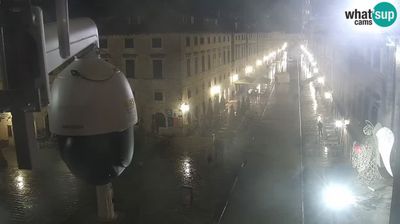





Dubrovnik has served as a maritime trading centre on Croatia’s Adriatic coast since the Middle Ages. Once the Republic of Ragusa, the city preserved its autonomy through diplomacy and seaborne commerce until the republic was abolished in 1808. Limestone walls enclose the UNESCO-listed Old City, where the broad Stradun runs between Pile Gate and the old harbour. Baroque churches, palaces and fountains reflect the rebuilding that followed the 1667 earthquake, while Fort Lovrijenac rises from a rocky promontory west of the walls. Find related webcams across Dubrovnik-Neretva County to build a fuller picture of Dubrovnik and the southern Adriatic.
1 webcam
Shaped by the sea routes of the southern Adriatic, Dubrovnik-Neretva County grew into Croatia’s southernmost county. Its territory is notably fragmented: the walled city of Dubrovnik faces the Adriatic, while the Pelješac Peninsula and the islands of Korčula, Mljet and Lastovo extend along the coast. The Neretva River reaches the sea north of Pelješac, forming Croatia’s best-known delta landscape. Dubrovnik’s Old City, once the centre of the Republic of Ragusa, is enclosed by renowned defensive walls and is UNESCO-listed. Mljet brings a quieter, wooded island character, centred on a national park with saltwater lakes. Continue through nearby webcams to explore different parts of Dubrovnik-Neretva County.
19 webcams
Croatia occupies a long Adriatic coastline in southeastern Europe. Its shore is broken into islands and sheltered coves, while the Dinaric Alps rise inland and the Danube forms part of its eastern border. Dubrovnik’s fortified old city faces the sea, and Split grew around Diocletian’s Palace, a Roman complex begun in the early fourth century. Inland, Plitvice Lakes National Park is known for terraced lakes linked by waterfalls and has been a UNESCO World Heritage Site since 1979. Istrian olive groves, Zagreb and Slavonia’s vineyards reveal distinct regional identities. Explore nearby webcam locations that provide complementary perspectives on the Adriatic coast and Croatia’s interior.
380 webcams