 Brno
The landscape around Brno is gently rolling and shaped by river valleys, which has influenced both the built environment and local life. The city stands near the confluence of the Svratka and Svitava rivers, while wooded hills rise around its broad central basin. Husova and Joštova form part of the busy inner-city street network, where tram lines run past public buildings, mature trees and late-19th-century architecture. Close by stands the Red Church, the neo-Gothic Evangelical Church of Jan Amos Comenius, built in the 1860s. Brno is the capital of the South Moravian Region and a major Czech university city; Špilberk Castle, on a hill above the historic centre, recalls its long role as a fortified Moravian centre.
Generated by AI

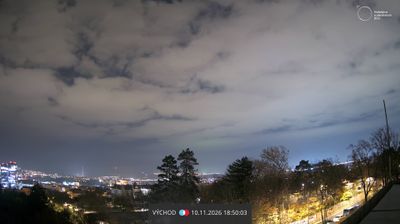

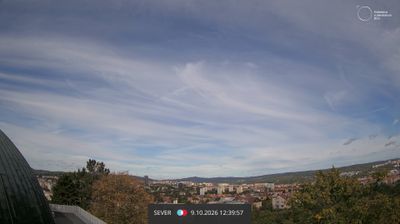
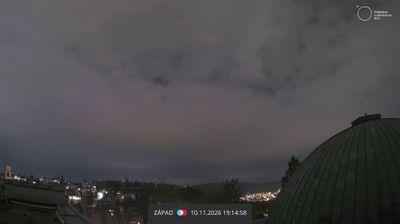



Brno sits at the meeting of the Svratka and Svitava rivers in Czechia’s South Moravian Region, where a major university city meets the wine-growing countryside of Moravia. The country’s second-largest city has long been the historic centre of Moravia, with the twin spires of the Cathedral of St Peter and Paul rising above its old core. Nearby, Špilberk Castle began as a 13th-century royal castle and later served as a fortress and prison. Brno is also home to Villa Tugendhat, Ludwig Mies van der Rohe’s 1930 modernist house, inscribed on the UNESCO World Heritage List. Move on to other webcams in South Moravia to compare city streets, river corridors and vineyard settings around Brno.
12 webcams
South Moravian Region has acted as a cultural crossroads within the Czech lands since the Middle Ages. Brno, Czechia’s second-largest city, is its urban centre, with Špilberk Castle recalling its long strategic role. The region extends across the warm lowlands of the Morava and Dyje rivers, where vineyards shape the countryside around Mikulov and Znojmo. To the north, the Moravian Karst is known for its limestone caves and the Macocha Abyss. The Lednice–Valtice Cultural Landscape, a UNESCO World Heritage Site, combines formal estates, follies and parkland near the Austrian border. Continue with other webcams from the area to see how this part of South Moravia connects regionally.
93 webcams
The terrain of Czechia ranges from fertile lowlands in southern Moravia to mountain ridges along the northern frontier, giving this Central European country a distinctly varied geography. The Vltava runs through Prague before joining the Elbe, while the Krkonoše form part of the border with Poland and include Sněžka, Czechia’s highest mountain. Prague’s historic centre, with Prague Castle and Charles Bridge, reflects the city’s long role as a political and cultural centre. Beyond the capital, Bohemia is known for spa towns and brewing, and Moravia for wine-growing traditions. View additional webcams nearby to better understand how Czechia relates to its Central European surroundings.
1.4K webcams