 Faenza
 is best known within Emilia-Romagna for its long-established tradition of maiolica ceramics. This rural corner lies in the rolling foothills of the Apennines, south of the city, where vineyards, orchards and small fields follow the folds of the terrain. Faenza gave its name to faience, the tin-glazed earthenware produced here from the Renaissance onward and traded widely across Europe. Its International Museum of Ceramics preserves works from the local tradition alongside collections from around the world. The surrounding countryside belongs to Romagna, a part of Emilia-Romagna where the Po Valley plain quickly gives way to cultivated hills.
Generated by AI



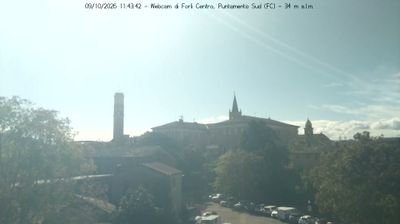
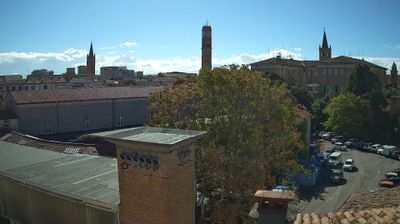

Faenza has served as a centre of ceramic production in Emilia-Romagna since the Renaissance. Set on the Lamone River between Bologna and Ravenna, the city gave its name to faience, the tin-glazed earthenware that travelled from its workshops across Europe. The International Museum of Ceramics, founded in 1908, traces the story of this craft from ancient vessels to contemporary design, while local ateliers continue the tradition. Around Piazza del Popolo, arcaded streets lead towards the Neoclassical Palazzo Milzetti, whose interiors were decorated by Felice Giani. Discover other points of interest through webcams located across Emilia-Romagna.
4 webcams
Emilia-Romagna occupies a broad stretch of the Po Valley and northern Apennines in Italy. From the agricultural plains around Modena and Bologna, the region extends northeast towards the Adriatic, where the wetlands of the Po Delta meet the sea. Wooded Apennine ridges give its southern districts a contrasting terrain. Bologna is home to one of the world’s oldest universities, founded in 1088, while Modena is closely linked with traditional balsamic vinegar. Parmigiano Reggiano and Prosciutto di Parma are further markers of a food culture known well beyond Italy. Continue through nearby webcams to explore different parts of Emilia-Romagna.
241 webcams
Among the countries of southern Europe, Italy stands out for its Mediterranean coastline and cities marked by the legacy of ancient Rome. The Alps form its northern frontier, while the Apennines run down the peninsula and the Po crosses the broad plain of the north. Rome’s Colosseum and Roman Forum recall the ancient empire; Florence is closely associated with the Renaissance, and Venice is built across a lagoon on the Adriatic. Food changes markedly between regions, from olive-oil cooking in the south to rice dishes in the Po Valley. Sicily and Sardinia add distinct island identities to a country whose regions retain strong local character. Explore nearby webcam locations that provide complementary perspectives on Italy’s coasts, cities and mountains.
3.1K webcams