 Punnuksen kunta
Krasnoye Ozero occupies a wooded shore of Lake Krasnoye on the Karelian Isthmus in Leningrad Oblast. The recreation area lies in low, lake-dotted terrain between the Gulf of Finland and Lake Ladoga. Its waterfront combines jetties, timber terraces and leisure facilities with wooded slopes equipped for downhill sports, giving the site a distinctly recreational rather than urban character. The Karelian Isthmus has long been a borderland between Finland and Russia, a history that gives the wider landscape a particular cultural context. Here, small-scale lakeside infrastructure, forest and water define the setting rather than dense development.
Generated by AI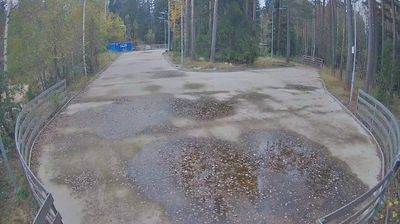





Punnuksen kunta lies on the Karelian Isthmus between the Gulf of Finland and Lake Ladoga, where forests, lakes and gently rolling terrain define this inland part of Leningrad Oblast. It belongs to a borderland whose place names recall the isthmus’s Finnish past: this area was part of Finland before the Second World War and became part of the Soviet Union after it. Rather than an urban centre, Punnuksen kunta is a point of reference in the sparsely settled countryside of Vyborg District. See how Punnuksen kunta fits within the Karelian Isthmus by browsing webcams nearby.
2 webcams
Among Russia’s regions, Leningrad Oblast stands apart for its Baltic coastline and extensive shores along Lake Ladoga. The oblast surrounds Saint Petersburg and stretches east from the Gulf of Finland into a territory of coniferous forest, wetlands and broad waterways. The Svir connects Lake Onega with Lake Ladoga, while the Volkhov flows north toward Ladoga. Staraya Ladoga, on the Volkhov, is among Russia’s oldest settlements, and its fortress recalls the area’s place in early Russian history. Coastal towns, inland rivers and forest country give the region a distinct character beyond the metropolis. View additional webcams nearby to better understand how Leningrad Oblast relates to northwestern Russia.
7 webcams
Russia has served as a major power between Europe and Asia since the 16th century. Its territory crosses eleven time zones, extending from the Baltic coast and the East European Plain over the Ural Mountains to the Pacific. The Volga, Europe’s longest river, runs through a core of historic Russian settlement, while Lake Baikal in Siberia is the world’s deepest lake. Moscow’s Kremlin and Red Square stand at the centre of the capital’s political and architectural heritage; Saint Petersburg’s Hermitage Museum occupies the Winter Palace. Orthodox churches, Russian-language literature, ballet and long-distance rail travel remain familiar reference points in a country of immense regional contrasts. Continue with other webcams from Russia to see how this part of northern Eurasia connects regionally.
462 webcams