 Vaux-sur-Mer: Plage de Nauzan
Built around an Atlantic shoreline, Vaux-sur-Mer grew into a seaside commune on France’s Côte de Beauté. Plage de Nauzan occupies a sandy, tide-shaped bay between low points of land on the coast immediately north of Royan. The beach belongs to a continuous resort shore shared with neighbouring Saint-Palais-sur-Mer, where homes, holiday residences and coastal paths follow the curve of the bay. Away from the waterfront, Vaux-sur-Mer retains the Romanesque Church of Saint-Étienne, whose origins date to the 12th century. This meeting of an older parish settlement and a developed resort coast defines the town’s character in Charente-Maritime.
Generated by AI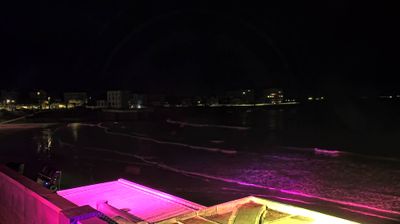

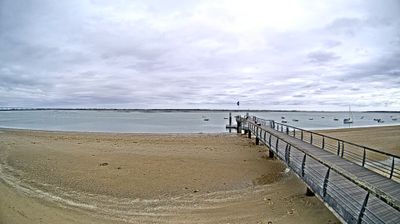
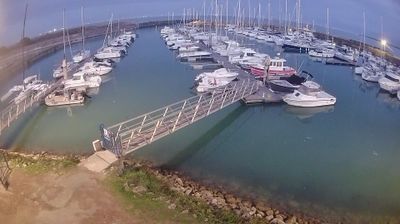
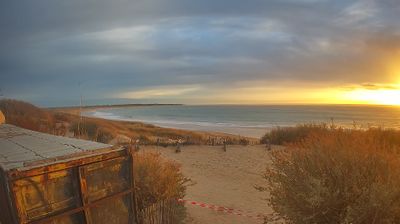

Vaux-sur-Mer sits on the Côte de Beauté, France’s Atlantic shoreline in Nouvelle-Aquitaine, where small sandy coves meet low rocky headlands north of the Gironde estuary. Adjoining Royan, it is part of the Charente-Maritime coast, a shore long associated with holiday villas, bathing beaches and walks along the water. Plage de Nauzan is the town’s best-known beach, while the Romanesque Church of Saint-Étienne provides a medieval counterpoint away from the seafront. The coves at Saint-Sordelin and Conseil give Vaux-sur-Mer a more fragmented shoreline than Royan’s broad central beach. Browse nearby coastal webcams to gain a fuller sense of the Côte de Beauté around Vaux-sur-Mer.
1 webcam
The Atlantic coastline and the Garonne–Dordogne river basin define much of Nouvelle-Aquitaine, supporting vineyards, agriculture and enduring maritime trade. France’s largest region brings together the surf beaches and pine forests of the Landes, the wine country around Bordeaux, and the limestone valleys of the Dordogne. The Charente passes through Angoulême, near this location; the city is internationally associated with its annual comics festival. Bordeaux also preserves the UNESCO-listed historic centre known as the Port of the Moon, recalling its role in Atlantic commerce. Cognac production in the Charente adds another internationally recognised local tradition. Browse related webcams around Nouvelle-Aquitaine to form a broader impression of this varied region.
125 webcams
The Atlantic and Mediterranean coastlines, together with the Alps, Pyrenees and broad river basins, define much of France — they support maritime trade, farming, wine regions and travel throughout the year. The Seine runs through Paris, where the Eiffel Tower and the Louvre are among Europe’s most recognised landmarks. The Loire Valley is known for Renaissance châteaux, while Mont-Saint-Michel rises from a tidal bay in Normandy. Regional food traditions are equally distinctive, from Breton seafood to Provençal cooking, with bread, cheese and wine central to everyday life. France’s global cultural influence is evident in its language, literature, fashion and cinema. View additional webcams nearby to better understand how France’s coasts, plains and mountain borders relate to their surroundings.
2.2K webcams