 Cuenca: Plaza Mayor
Cuenca lies between the deep gorges of the Júcar and Huécar rivers, its historic core standing on a narrow rocky spur above the water. Plaza Mayor is the civic heart of the old town, enclosed by tall, irregularly aligned houses and the Cathedral of Santa María and San Julián. Begun after the Christian conquest of the city in the 12th century, the cathedral is among Spain’s earliest Gothic churches, with later Romanesque, Renaissance and Baroque additions. Cuenca’s old town was inscribed on UNESCO’s World Heritage List in 1996. Beyond the square, lanes follow the ridge towards the Casas Colgadas, the famous houses that project over the Huécar gorge and give this Castile-La Mancha city its dramatic urban form.
Generated by AI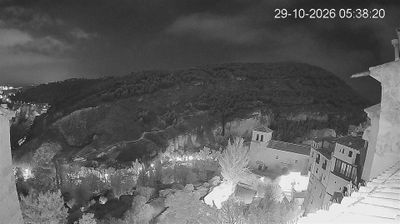

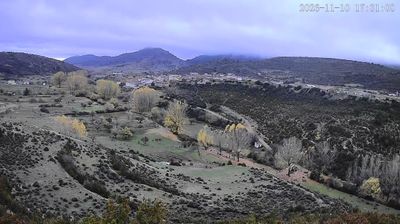


Cuenca sits above the gorges of the Júcar and Huécar rivers in Castile-La Mancha, Spain, where its historic core occupies a narrow rocky spur. The old upper town, encircled by deep ravines, was inscribed on UNESCO’s World Heritage List in 1996 for its fortified setting and architecture. Its best-known landmark is the Casas Colgadas, a group of houses with wooden balconies projecting over the Huécar gorge; one contains the Museum of Spanish Abstract Art. Cuenca Cathedral, begun after the Castilian conquest in the 12th century, anchors Plaza Mayor. Explore additional webcams nearby to understand how Cuenca’s river-cut setting connects with the wider Serranía de Cuenca.
2 webcams
Castile-La Mancha combines broad open plains with rugged mountain country in a way that reflects its position within Spain’s central Meseta. La Mancha occupies much of its centre, where cereal fields, vineyards and long horizons shape an intensely continental interior. The Guadiana crosses the region, while the Montes de Toledo and the Sierra de Alcaraz break the plateau to the south. Cervantes set key episodes of Don Quixote in La Mancha, making its windmills an enduring emblem of Spanish literature. Toledo, the regional capital, preserves a historic centre on a bend of the Tagus. Move on to other webcams in the region to compare landscapes and settings around Castile-La Mancha.
26 webcams
Spain extends from the Cantabrian coast to the Canary Islands, encompassing Atlantic shores, Mediterranean beaches and the broad interior Meseta. The Pyrenees form its northeastern frontier, while the Guadalquivir crosses Andalusia on its way to the Atlantic. Madrid anchors the country’s political and cultural life, but distinct regional identities are central to Spain’s character: Catalonia, the Basque Country, Galicia and Andalusia each have their own languages or strong local traditions. Granada’s Alhambra is a major monument of the medieval Nasrid dynasty, and Santiago de Compostela remains the destination of the Camino de Santiago. Browse related webcams around the Iberian Peninsula to build a fuller picture of Spain.
1.4K webcams