 Szczytno: Plac Juranda
Built around a Teutonic castle, Szczytno grew into the administrative centre of its district in southern Masuria. Plac Juranda stands beside the surviving masonry of the castle, whose origins date to the fourteenth century, and beside Lake Domowe Małe. The square takes its name from Jurand of Spychów, a central character in Henryk Sienkiewicz’s novel The Teutonic Knights. Szczytno lies between Lake Domowe Małe and the larger Lake Domowe Duże, making water a defining element of its urban setting. Streets, public buildings and lakeside paths bring the old core of this Masurian town together at the water’s edge.
Generated by AI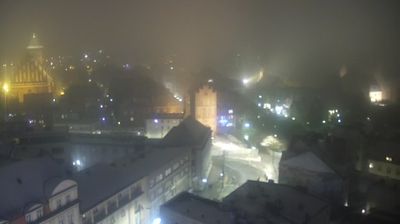


Szczytno sits between Lake Domowe Małe and Lake Domowe Duże in Poland’s Warmian-Masurian Voivodeship, where the town centre is shaped by two closely adjoining lakes. It stands in historic Masuria, a region with intertwined Polish, German and Masurian traditions; Szczytno was formerly known by its German name, Ortelsburg. Ruins of a Teutonic Order castle remain near the old centre, and the Masurian Museum presents regional ethnographic heritage. Lakeside paths, beaches and a compact urban core give the town a more local character than the larger resorts of the Masurian Lake District. Continue with other webcams from the area to see how this part of Masuria connects regionally.
1 webcam
Warmian-Masurian Voivodeship combines tranquil lake country with the urban heritage of Warmia in a way that reflects its position between Warmia and Masuria in northeastern Poland. The Great Masurian Lakes form the region’s best-known water network, with Lake Śniardwy the largest lake in Poland. Forests, farmland and waterways spread across a borderland shaped by Polish, German and Prussian histories. In Olsztyn, the former castle of the Warmian chapter is associated with Nicolaus Copernicus, who administered its estates. The regional capital is also a useful starting point for journeys through the lake district and its smaller towns. Browse additional webcams from the surrounding area to extend your view of Warmia and Masuria.
30 webcams
Poland stretches from the Baltic Sea coast in the north to the Carpathian Mountains along its southern frontier, encompassing broad lowlands, lake districts and upland ranges. The Vistula, the country’s longest river, links Kraków and Warsaw before reaching the Baltic near Gdańsk, while the Masurian Lake District is defined by a dense network of lakes. Kraków’s historic centre, including Wawel Castle, recalls Poland’s former royal capital; Warsaw’s rebuilt Old Town speaks to the city’s recovery after the Second World War. The Białowieża Forest preserves one of Europe’s last primeval lowland forests and is home to European bison. Follow how Poland’s regions relate to one another by browsing webcams across the country.
709 webcams