 Radom: Marszałka Józefa Piłsudskiego - Henryka Sienkiewicza
The Mleczna River defines the setting of Radom — its low valley has helped shape a broad, largely level urban centre in southern Mazovia. Henryka Sienkiewicza Street meets Marszałka Józefa Piłsudskiego Street among substantial historic townhouses and civic buildings, giving this part of the city a distinctly urban scale. Radom received town rights in 1340 under King Casimir III the Great, and its centre reflects its long role as a regional hub. The street names commemorate Henryk Sienkiewicz, Poland’s Nobel Prize-winning novelist, and Józef Piłsudski, a leading figure in the restoration of Polish independence.
Generated by AI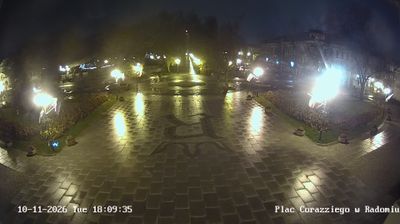
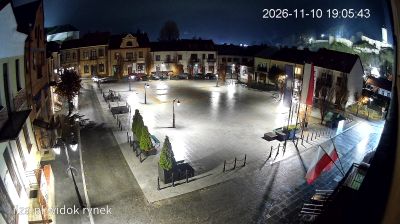


Among the cities of the Masovian Voivodeship, Radom stands out for hosting the 1505 Sejm that adopted the Nihil novi act, a landmark in the development of Poland’s parliamentary system. The Mleczna River runs through the city, whose historic core recalls Radom’s importance in the medieval Kingdom of Poland. The Gothic Church of St John the Baptist is one of its enduring old-town monuments. The Jacek Malczewski Museum honours the Symbolist painter born here and presents art alongside regional collections. Place Radom within the wider Masovian region by browsing webcams nearby.
2 webcams
Masovian Voivodeship combines the metropolitan momentum of Warsaw with the open character of river plains in a way that reflects its position within Poland’s central lowlands. The Vistula runs through the region and past the capital, whose historic centre was rebuilt after the Second World War and is listed by UNESCO. Beyond Warsaw, Masovia spreads into farmland, woodland and smaller towns, with the Bug and Narew among the waterways shaping its eastern and northern reaches. This is Poland’s political centre, but regional customs also endure in local food, music and seasonal events. Explore nearby locations that provide complementary perspectives on Masovia.
33 webcams
Poland stretches from the Baltic Sea coast in the north to the Carpathian Mountains along its southern frontier, encompassing broad lowlands, lake districts and upland ranges. The Vistula, the country’s longest river, links Kraków and Warsaw before reaching the Baltic near Gdańsk, while the Masurian Lake District is defined by a dense network of lakes. Kraków’s historic centre, including Wawel Castle, recalls Poland’s former royal capital; Warsaw’s rebuilt Old Town speaks to the city’s recovery after the Second World War. The Białowieża Forest preserves one of Europe’s last primeval lowland forests and is home to European bison. Follow how Poland’s regions relate to one another by browsing webcams across the country.
709 webcams