 Lugo: Emilia-Romagna, Italy: Eurospin Zone
The landscape around Lugo is flat and agricultural, which has shaped both the built environment and local life. The town lies on the Romagna plain, within the wider Po River valley, where low-rise neighbourhoods, orchards and cultivated fields extend across level ground. Lugo developed as a market centre for the surrounding countryside, and its historic core still centres on the Rocca Estense, a moated fortress with four corner towers. Nearby, the Pavaglione’s long arcades recall the town’s former cocoon market, once tied to the regional silk trade. Lugo is also the birthplace of First World War flying ace Francesco Baracca, commemorated by a museum in the Rocca.
Generated by AI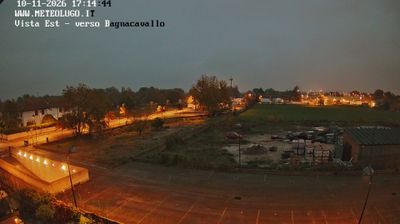
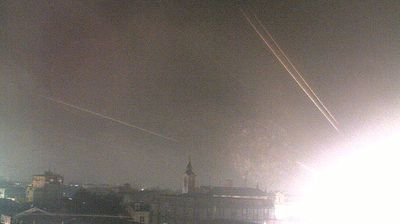
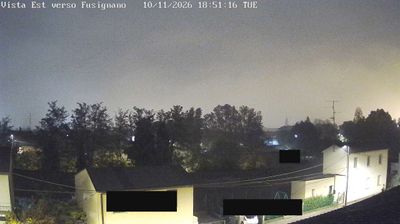
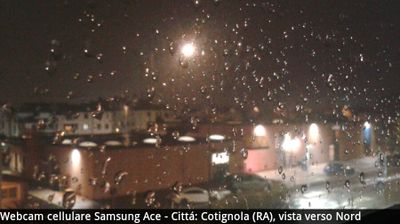




Lugo straddles the Canale dei Mulini on Emilia-Romagna’s Romagna plain, and this water-managed setting helped shape it as a trading centre for the surrounding farmland. The town’s Pavaglione, an 18th-century quadrangular portico, was built for the silk-cocoon market and remains a defining element of the historic centre. The Rocca Estense began as a medieval fortress and was later reshaped under the Este dynasty. Lugo is also the birthplace of First World War flying ace Francesco Baracca, whose former home is now a museum dedicated to his life. Explore nearby webcam locations that provide complementary perspectives on Lugo and the Romagna plain.
4 webcams
Emilia-Romagna occupies a broad stretch of the Po Valley and northern Apennines in Italy. From the agricultural plains around Modena and Bologna, the region extends northeast towards the Adriatic, where the wetlands of the Po Delta meet the sea. Wooded Apennine ridges give its southern districts a contrasting terrain. Bologna is home to one of the world’s oldest universities, founded in 1088, while Modena is closely linked with traditional balsamic vinegar. Parmigiano Reggiano and Prosciutto di Parma are further markers of a food culture known well beyond Italy. Continue through nearby webcams to explore different parts of Emilia-Romagna.
242 webcams
Among the countries of southern Europe, Italy stands out for its Mediterranean coastline and cities marked by the legacy of ancient Rome. The Alps form its northern frontier, while the Apennines run down the peninsula and the Po crosses the broad plain of the north. Rome’s Colosseum and Roman Forum recall the ancient empire; Florence is closely associated with the Renaissance, and Venice is built across a lagoon on the Adriatic. Food changes markedly between regions, from olive-oil cooking in the south to rice dishes in the Po Valley. Sicily and Sardinia add distinct island identities to a country whose regions retain strong local character. Explore nearby webcam locations that provide complementary perspectives on Italy’s coasts, cities and mountains.
3.1K webcams