 Rovinj: Trg Maršala Tita - Port of Rovinj
Rovinj occupies a compact peninsula on Croatia’s western Istrian coast, projecting into the Adriatic Sea. Its harbour and Trg Maršala Tita form the meeting point between the old town’s steep, tightly built lanes and a broad waterfront used by fishing boats, excursion vessels and small craft. The square is marked by Rovinj’s clock tower, while the baroque Church of St Euphemia rises above the peninsula as the city’s defining landmark. Rovinj was an island until the channel separating it from the mainland was filled in 1763, and centuries under Venetian rule remain evident in the Italianate façades, shutters and stone-paved streets. The harbour continues to be central to the town’s daily rhythm and its links with the Istrian coast.
Generated by AI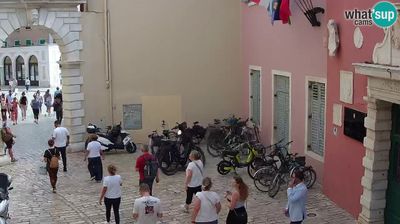
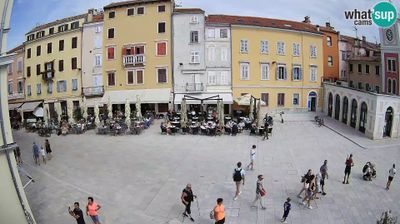
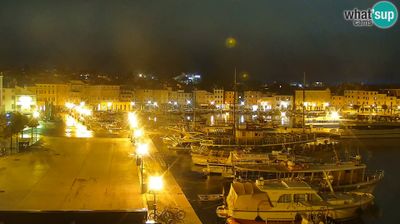
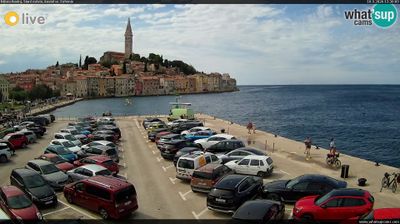
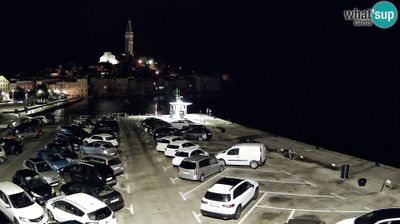

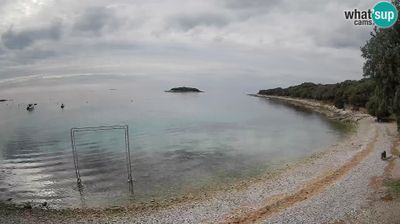
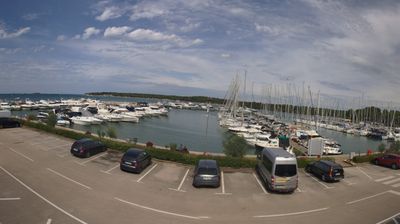

Rovinj has served as a fishing and maritime port on Istria’s Adriatic coast since the Middle Ages. Its compact old town rose on an island, separated from the mainland until the channel was filled in 1763, and steep lanes still lead up to the Baroque Church of St Euphemia. The church’s Venetian-style bell tower is Rovinj’s defining landmark. Fishing traditions, waterfront restaurants and Italian-influenced Istrian cuisine reflect long connections across the northern Adriatic, while the coast north of town approaches the Lim Bay inlet. Explore nearby webcam locations that provide complementary perspectives on Rovinj and Istria’s Adriatic coast.
2 webcams
The Adriatic coastline and limestone interior define much of Istria County – together they support tourism, vineyards, olive groves and smaller farms. Croatia’s westernmost county occupies most of the Istrian peninsula, where the Mirna River runs through northern valleys towards the sea. Pula’s Roman amphitheatre is among its best-known historic landmarks, while Poreč’s Euphrasian Basilica is inscribed on UNESCO’s World Heritage List. Rovinj and other old coastal ports recall centuries of Adriatic trade; inland, hill towns and regional food traditions create a markedly different rhythm. Discover nearby webcam locations for complementary perspectives on Istria County.
45 webcams
Croatia occupies a long Adriatic coastline in southeastern Europe. Its shore is broken into islands and sheltered coves, while the Dinaric Alps rise inland and the Danube forms part of its eastern border. Dubrovnik’s fortified old city faces the sea, and Split grew around Diocletian’s Palace, a Roman complex begun in the early fourth century. Inland, Plitvice Lakes National Park is known for terraced lakes linked by waterfalls and has been a UNESCO World Heritage Site since 1979. Istrian olive groves, Zagreb and Slavonia’s vineyards reveal distinct regional identities. Explore nearby webcam locations that provide complementary perspectives on the Adriatic coast and Croatia’s interior.
381 webcams