 Oberweid: Kirche St. Michael
Built around a network of farmsteads in the Rhön, Oberweid grew into a compact village in Thuringia. It lies among the rounded, wooded uplands of the Rhön, the low mountain range shared by Thuringia, Hesse and Bavaria. Red-tiled roofs, timber-framed houses and St Michael’s Church define its settled core. The wider Rhön is recognised as a UNESCO Biosphere Reserve, reflecting a cultural landscape where forested slopes meet open fields and small communities. Oberweid retains the close relationship between rural building traditions and the highland terrain that characterises this part of central Germany.
Generated by AI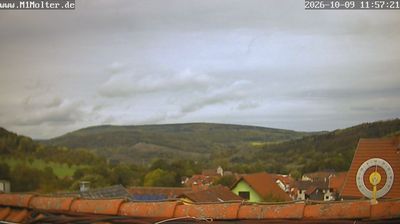




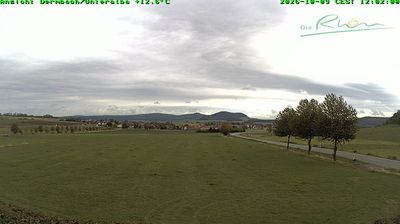

Oberweid straddles the small valleys between the wooded ridges of the Thuringian Rhön in southwestern Thuringia, and this upland setting has long linked the settlement to farming and forestry. The municipality forms part of the Rhön Biosphere Reserve, a UNESCO-designated landscape extending across Thuringia, Hesse and Bavaria. Meadows, hedgerows and woodland define the surrounding countryside, while the Rhön sheep remains a well-known regional breed associated with its pasture traditions. Trace Oberweid’s place in the Thuringian Rhön by browsing webcams across nearby towns and ridges.
2 webcams
Thuringia has served as a cultural crossroads within central Germany since the Middle Ages. Its varied terrain runs from the wooded ridges of the Thuringian Forest to the Saale valley in the east, with the long-distance Rennsteig trail following the forest’s crest. Erfurt, the state capital, preserves a historic centre marked by the cathedral and the Krämerbrücke, a bridge lined with inhabited buildings. Weimar is closely associated with Goethe and Schiller and with the Bauhaus movement, while Wartburg Castle near Eisenach recalls the region’s medieval past. Browse additional webcams from the surrounding area to extend your view of Thuringia.
76 webcams
Germany stretches from the North Sea and Baltic Sea coasts to the Alps on its southern border, encompassing northern plains, river valleys and forested uplands. The Rhine, Danube and Elbe have long connected its regions, while the Black Forest and Bavarian Alps give the south a more dramatic relief. Berlin’s Brandenburg Gate and Museum Island reflect the capital’s role in German history and culture. Cologne Cathedral, a UNESCO World Heritage Site, rises above the Rhine, and the Bauhaus movement, founded in Weimar in 1919, transformed modern design far beyond Germany. Regional cooking, Christmas markets and brewing traditions bring further character to daily life. Browse additional webcams from the surrounding area to extend your view of Germany.
2.8K webcams