 Klinčany: Брузги. Онлайн очередь (выезд из Республики Беларусь)
Few places in Hrodna Region have a history as closely tied to Belarus’s western frontier as Klinčany. Set beside the M6 road corridor near the Polish border, this small settlement occupies a functional landscape of wide carriageways, roadside facilities and woodland. It lies in the wider Grodno area, where the Neman River passes through the regional centre. Grodno developed as an important town of the Grand Duchy of Lithuania and later the Polish–Lithuanian Commonwealth; its last Sejm convened there in 1793. Klinčany is defined less by an urban core than by the transport artery and borderland setting linking Belarus with Poland.
Generated by AI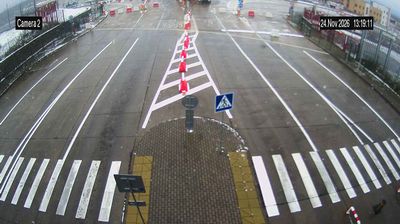

Klinčany has served as a rural settlement in Belarus’s Hrodna Region since its establishment. It lies in the country’s western borderland, amid low, cultivated terrain and small settlements south of the regional centre of Hrodna. The Neman is the principal river of the wider region, flowing through Hrodna and shaping a basin that extends towards Lithuania. Hrodna Region has long linked Belarus with Poland and Lithuania, a position reflected in Belarusian, Polish and Lithuanian cultural traditions. View additional webcams nearby to better understand how Klinčany relates to its surroundings.
1 webcam
Hrodna Region has served as an administrative region within Belarus since 1944. In the country’s northwest, it meets Lithuania and Poland, and its landscapes are organised by the Neman River, farmland, woodland and small towns. Hrodna, the regional capital on the Neman, is known for its historic centre and the Old and New Castles, which recall the city’s importance in the Grand Duchy of Lithuania and the Polish-Lithuanian Commonwealth. Lida Castle, built in the 14th century under Grand Duke Gediminas, is another major medieval landmark. The Augustów Canal crosses the western part of the region, linking the Neman basin towards Poland. View additional webcams nearby to better understand how Hrodna Region relates to its borderland surroundings.
2 webcams
Belarus is best known internationally for its production of potash fertilisers, a major export from this landlocked eastern European country. Its largely low-lying terrain is crossed by the Dnieper, Neman and Pripyat rivers, while the southern Polesie region includes extensive wetlands and forests. Belovezhskaya Pushcha, shared with Poland, protects part of the ancient Białowieża Forest and is associated with European bison. Minsk combines Soviet-era avenues with the historic Upper Town, and the UNESCO-listed Mir Castle Complex and Radziwiłł residence at Nesvizh recall the era of the Grand Duchy of Lithuania. Move on to other webcams in the region to compare landscapes and settings around Belarus.
4 webcams