 Umag: Ulica 1. Svibnja
Ulica 1. svibnja in Umag combines the sociable tempo of a café square with the compact scale of an old coastal town in a way that reflects its Adriatic position. The paved public space, with its fountain and terraces, forms part of central Umag on the western shore of the Istrian Peninsula. The Adriatic Sea has shaped the town’s identity through its harbour and waterfront, while narrow streets lead into the historic core. Umag grew from a Roman settlement and was under Venetian rule from the 13th century until 1797. That era remains legible in the old town, which occupies a small peninsula. Ulica 1. svibnja places a contemporary civic meeting point close to this older urban fabric, linking everyday café life with Umag’s coastal heritage.
Generated by AI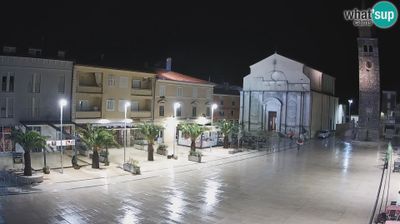
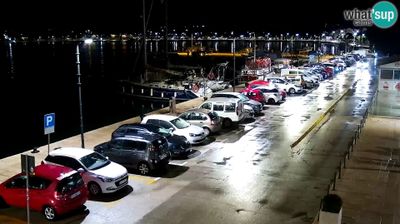
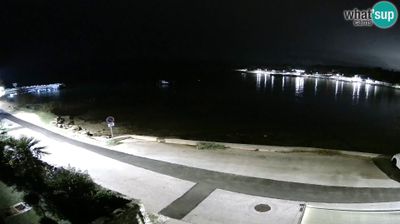

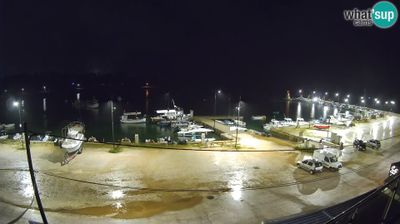



Umag lies along the Adriatic coast of northwestern Istria, where a low, indented shoreline meets the open sea near Croatia’s border with Slovenia. Its compact old town occupies a peninsula that was once an island, retaining narrow lanes, fragments of defensive walls and buildings shaped by centuries under Venetian rule. The Church of the Assumption of the Blessed Virgin Mary and Saint Peregrine anchors the historic centre, while the annual Plava Laguna Croatia Open brings international tennis to the Stella Maris resort area. Beyond town, the coast leads towards Savudrija and its 19th-century lighthouse. Move on to other webcams in the region to compare landscapes and settings around Umag and Istria County.
2 webcams
The Adriatic coastline and limestone interior define much of Istria County – together they support tourism, vineyards, olive groves and smaller farms. Croatia’s westernmost county occupies most of the Istrian peninsula, where the Mirna River runs through northern valleys towards the sea. Pula’s Roman amphitheatre is among its best-known historic landmarks, while Poreč’s Euphrasian Basilica is inscribed on UNESCO’s World Heritage List. Rovinj and other old coastal ports recall centuries of Adriatic trade; inland, hill towns and regional food traditions create a markedly different rhythm. Discover nearby webcam locations for complementary perspectives on Istria County.
45 webcams
Croatia occupies a long Adriatic coastline in southeastern Europe. Its shore is broken into islands and sheltered coves, while the Dinaric Alps rise inland and the Danube forms part of its eastern border. Dubrovnik’s fortified old city faces the sea, and Split grew around Diocletian’s Palace, a Roman complex begun in the early fourth century. Inland, Plitvice Lakes National Park is known for terraced lakes linked by waterfalls and has been a UNESCO World Heritage Site since 1979. Istrian olive groves, Zagreb and Slavonia’s vineyards reveal distinct regional identities. Explore nearby webcam locations that provide complementary perspectives on the Adriatic coast and Croatia’s interior.
380 webcams