 Fara San Martino
Lago Sant’Angelo lies in the Aventino valley in Abruzzo, its reservoir enclosed by cultivated slopes and wooded foothills of the central Apennines. It belongs to the area around Civitella Messer Raimondo, a small settlement on the eastern side of the Majella massif. This is inland Abruzzo: a mosaic of woodland, fields and scattered hillside communities rather than a resort shore. The surrounding valleys form part of an old pastoral landscape shaped by transhumance, the seasonal movement of flocks between mountain pasture and lower ground. Lago Sant’Angelo provides a calm counterpoint to the higher, more rugged terrain of nearby Majella National Park.
Generated by AI
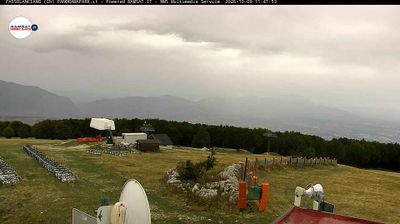
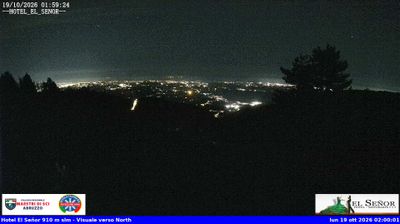
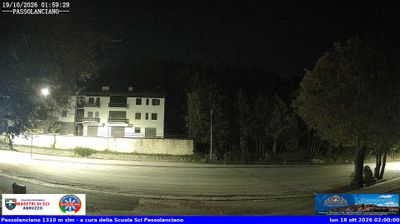
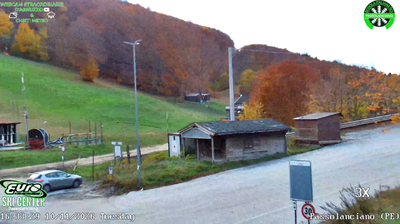
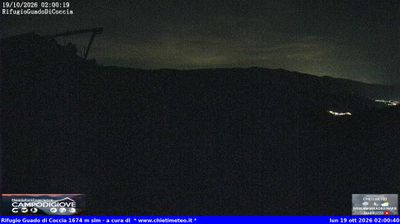
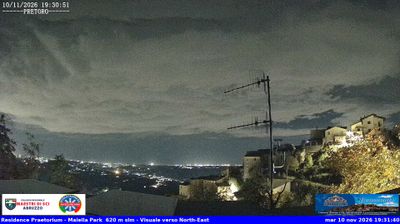

Fara San Martino has served as a pasta-making centre in Abruzzo since the late 19th century. Set beneath the limestone slopes of the Majella massif, the town is closely associated with the Verde River and the clear spring water long used by local producers. De Cecco, founded here in 1886, made Fara San Martino one of Italy’s best-known names in dried pasta. Above the settlement, the Gole di San Martino cut into the mountain and lead towards the remains of the Abbey of San Martino in Valle. Find related webcams in the surrounding Abruzzo area to build a fuller picture of Fara San Martino and the Majella.
1 webcam
Abruzzo occupies a mountainous stretch between the central Apennines and the Adriatic Sea in Italy. Much of its identity comes from protected uplands: the Gran Sasso massif includes Corno Grande, at 2,912 metres the highest summit of the Apennines, while the Majella rises farther south. Forest, high pastures and valleys descend towards a long Adriatic coast. L’Aquila, the regional capital, retains its medieval core, and Abruzzo’s food culture is noted for saffron from the Navelli plateau and Montepulciano d’Abruzzo wine. See how Abruzzo fits into the wider central Italian landscape by browsing webcams nearby.
119 webcams
Among the countries of southern Europe, Italy stands out for its Mediterranean coastline and cities marked by the legacy of ancient Rome. The Alps form its northern frontier, while the Apennines run down the peninsula and the Po crosses the broad plain of the north. Rome’s Colosseum and Roman Forum recall the ancient empire; Florence is closely associated with the Renaissance, and Venice is built across a lagoon on the Adriatic. Food changes markedly between regions, from olive-oil cooking in the south to rice dishes in the Po Valley. Sicily and Sardinia add distinct island identities to a country whose regions retain strong local character. Explore nearby webcam locations that provide complementary perspectives on Italy’s coasts, cities and mountains.
2.8K webcams