 Firenzuola: Valle del Diaterna - FI) - Alto Mugello - Appennino Tosco Emiliano
The Diaterna Valley defines the setting of Firenzuola — wooded ridges of the Tuscan-Emilian Apennines enclose a thinly settled upland of clearings, farms and hamlets. The Diaterna is a tributary of the Santerno, part of the drainage that crosses the Apennines toward the Adriatic. Firenzuola was founded by Florence in the 14th century as a fortified settlement on the route between Tuscany and Romagna; its name means “little Florence.” The surrounding Valle del Diaterna remains a rural borderland, where local roads follow the folds of the terrain rather than a broad valley floor. This is inland Tuscany at a markedly more mountainous scale than the region’s better-known hill-country landscapes.
Generated by AI

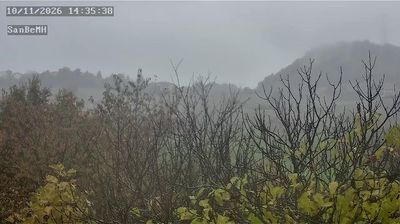
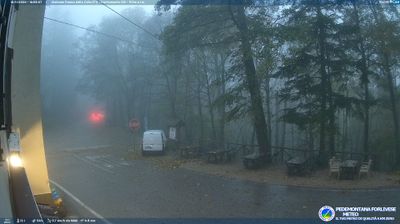
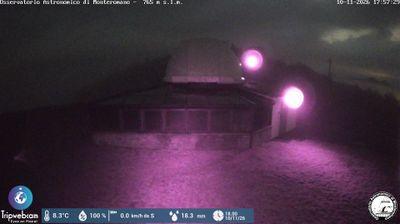

The landscape around Firenzuola is a rugged stretch of the Tuscan-Emilian Apennines, which has shaped both the town’s compact form and an economy long linked to woodland products and mountain farming. The upper Santerno valley places the community on the Tuscan side of the divide between Florence and Bologna, where roads have long followed the folds of the range. Founded by Florence in 1332 as a fortified settlement, Firenzuola preserves its historic centre and the remains of its Medici fortress. The town is also associated with pietra serena, the grey sandstone widely used in Tuscan architecture and quarried locally. Browse nearby webcams to discover other corners of the Tuscan-Emilian Apennines.
5 webcams
Tuscany occupies a central belt between the Apennines and the Tyrrhenian Sea in Italy. Near these coordinates, the undulating Val d’Elsa extends between Florence and Siena, its farmland marked by vineyards, olive groves and historic market towns. The Elsa flows into the Arno, the river that crosses Florence before reaching the coast. Siena’s medieval centre is centred on the Piazza del Campo, where the Palio horse race takes place twice each summer. Across Tuscany, olive oil, wine and seasonal cooking remain central to local identity, while its cities hold exceptional Renaissance art and architecture. Find related webcams in the surrounding area to build a fuller picture of the Val d’Elsa and central Tuscany.
168 webcams
Among the countries of southern Europe, Italy stands out for its Mediterranean coastline and cities marked by the legacy of ancient Rome. The Alps form its northern frontier, while the Apennines run down the peninsula and the Po crosses the broad plain of the north. Rome’s Colosseum and Roman Forum recall the ancient empire; Florence is closely associated with the Renaissance, and Venice is built across a lagoon on the Adriatic. Food changes markedly between regions, from olive-oil cooking in the south to rice dishes in the Po Valley. Sicily and Sardinia add distinct island identities to a country whose regions retain strong local character. Explore nearby webcam locations that provide complementary perspectives on Italy’s coasts, cities and mountains.
3.1K webcams