 Puerto del Rosario: Estadio Municipal de Los Pozos - Isla de Fuerteventura
Puerto del Rosario sits on the Atlantic coast of Fuerteventura in Spain’s Canary Islands, where a low-rise administrative town meets the island’s dry volcanic interior. Estadio Municipal de Los Pozos forms part of the town’s sporting infrastructure, close to the compact built-up area rather than a resort strip. As Fuerteventura’s capital, Puerto del Rosario concentrates public services, shops and ferry links, while its waterfront faces the Atlantic beside the harbour. The town is also associated with Miguel de Unamuno, who was exiled here in 1924; his former residence is now the Casa Museo Unamuno. Fuerteventura, a UNESCO Biosphere Reserve since 2009, is known for open, sparsely vegetated terrain shaped by volcanic geology and trade winds.
Generated by AI
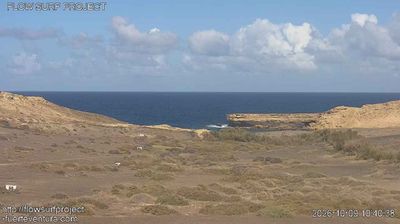


Puerto del Rosario has served as Fuerteventura’s administrative capital in the Canary Islands since the 1860s. Set on the island’s east-facing Atlantic coast, it is Fuerteventura’s main port and an urban counterpoint to the resort areas farther south. The town was called Puerto de Cabras until 1956, recalling its beginnings as a modest harbour on an arid volcanic island. Contemporary sculptures appear in streets and squares around the centre, while Casa Museo Unamuno recalls the 1924 exile on Fuerteventura of writer Miguel de Unamuno. Its low-rise waterfront and working harbour give the capital a distinctly local, practical character. Browse other webcams across Fuerteventura and the Canary Islands to place this setting in a wider geographic context.
1 webcam
The Canary Islands have served as an Atlantic crossroads within Spain since the fifteenth century. This volcanic archipelago lies off northwestern Africa, where the Atlantic Ocean, trade winds and sharply varying terrain shape climates ranging from dry coasts to cool uplands. Tenerife is home to Mount Teide, Spain’s highest peak, while the Teide National Park is a UNESCO World Heritage Site. Across the islands, black-sand shores, lava fields and cultivated slopes reflect their volcanic origins. Carnival traditions, especially those of Santa Cruz de Tenerife, remain an important part of the local calendar. View additional webcams nearby to better understand how the Canary Islands relate to the Atlantic and to one another.
73 webcams
Spain extends from the Cantabrian coast to the Canary Islands, encompassing Atlantic shores, Mediterranean beaches and the broad interior Meseta. The Pyrenees form its northeastern frontier, while the Guadalquivir crosses Andalusia on its way to the Atlantic. Madrid anchors the country’s political and cultural life, but distinct regional identities are central to Spain’s character: Catalonia, the Basque Country, Galicia and Andalusia each have their own languages or strong local traditions. Granada’s Alhambra is a major monument of the medieval Nasrid dynasty, and Santiago de Compostela remains the destination of the Camino de Santiago. Browse related webcams around the Iberian Peninsula to build a fuller picture of Spain.
1.4K webcams