 Olbernhau
Built around the Flöha valley, Olbernhau grew into a small Saxon town shaped by forestry, craft and industry. It lies in the Ore Mountains near Germany’s border with the Czech Republic, where wooded ridges and open meadows surround a compact centre of steep-roofed houses, civic buildings and local businesses. Its defining heritage site is the Saigerhütte Grünthal, a former metallurgical works whose surviving ensemble records centuries of copper processing. The Saigerhütte forms part of the UNESCO-listed Erzgebirge/Krušnohoří Mining Region, shared by Saxony and the Czech Republic. Traditional Erzgebirge woodcraft remains central to the wider area’s identity.
Generated by AI

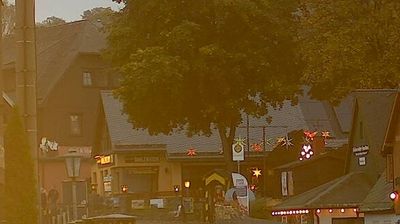

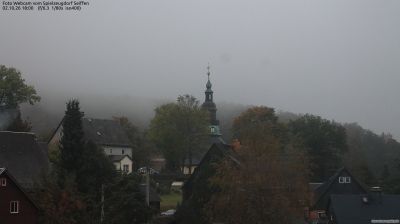




The landscape around Olbernhau is a wooded, rolling stretch of the Saxon Ore Mountains along the Flöha River, a setting that has influenced both its settlement pattern and working life. Close to the Czech border, the town belongs to a region long associated with metalworking, forestry and finely made wooden goods. At Grünthal, the Saigerhütte preserves a historic copper-processing complex whose origins reach back to the 16th century, while the wider area is also known for Erzgebirge Christmas traditions. Olbernhau is a useful base for exploring the mountain borderland on foot or by rail. Discover other points of interest through webcams located across Saxony’s Ore Mountains.
2 webcams
Saxony is renowned across Germany for Meissen porcelain, first produced in the town of Meissen in 1710. The state stretches from the Ore Mountains on the Czech border to the Elbe valley, whose banks include Dresden, Saxony’s capital. Dresden’s reconstructed Frauenkirche and the baroque Zwinger reflect its role as a historic court city, while Leipzig has long been associated with trade fairs and Johann Sebastian Bach, who worked at St Thomas Church. East of Dresden, the Elbe Sandstone Mountains create the striking rock country of Saxon Switzerland. Move on to other webcams in the region to compare landscapes and settings around Saxony.
168 webcams
Germany stretches from the North Sea and Baltic Sea coasts to the Alps on its southern border, encompassing northern plains, river valleys and forested uplands. The Rhine, Danube and Elbe have long connected its regions, while the Black Forest and Bavarian Alps give the south a more dramatic relief. Berlin’s Brandenburg Gate and Museum Island reflect the capital’s role in German history and culture. Cologne Cathedral, a UNESCO World Heritage Site, rises above the Rhine, and the Bauhaus movement, founded in Weimar in 1919, transformed modern design far beyond Germany. Regional cooking, Christmas markets and brewing traditions bring further character to daily life. Browse additional webcams from the surrounding area to extend your view of Germany.
2.8K webcams