 Iquique: Aeropuerto
Diego Aracena International Airport lies along Chile’s Pacific coast, on a broad desert plain where the Atacama meets the sea. Serving Iquique and the Tarapacá Region, it occupies an open strip of coastal desert shaped by runways, roads and low, barren ground rather than dense urban development. Iquique grew into a major port during the late-19th-century nitrate boom, a history reflected in the city’s historic quarter. Farther inland, the Humberstone and Santa Laura saltpeter works are a UNESCO World Heritage Site, recording the industry that transformed northern Chile. The airport links Iquique’s Pacific-facing urban coast with the arid interior of Tarapacá.
Generated by AI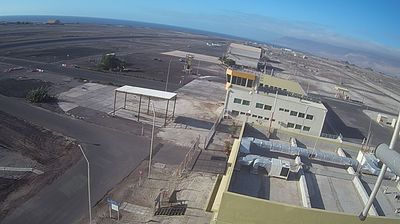

Tucked along Chile’s Pacific coast beside the Atacama Desert, Iquique is a place whose character is shaped by the meeting of an exceptionally dry interior and the ocean. The city developed as an important port during the 19th-century nitrate boom, and its historic quarter retains wooden buildings from that era, particularly along Baquedano Street. Playa Cavancha forms a broad urban beach, while the desert rises abruptly behind the coastal plain. The Humberstone and Santa Laura Saltpeter Works, a UNESCO World Heritage Site, recall the industry that transformed Tarapacá. Find related webcams in the surrounding area to build a fuller picture of Iquique and the Tarapacá Region.
2 webcams
The terrain of Tarapacá Region ranges from Pacific coastal plains in the west to high Andean plateaus in the east, creating one of Chile’s most arid and sharply contrasting regions. Much of its interior belongs to the Atacama Desert, where salt flats, ravines and wide open expanses surround settlements adapted to an exceptionally dry climate. Iquique, the regional capital on the coast, grew as a port during the nitrate boom. Inland, the UNESCO-listed Humberstone and Santa Laura Saltpeter Works preserve the industrial legacy that shaped northern Chile. High-altitude wetlands around Salar de Huasco add another dimension to this desert region. Explore related webcams in the surrounding north to build a fuller picture of Tarapacá Region.
2 webcams
Among the countries of South America, Chile stands out for its exceptional north-to-south extent between the Andes and the Pacific Ocean. The Atacama Desert in the north is one of the driest places on Earth, while the south reaches into Patagonia, where Torres del Paine National Park is known for its jagged granite peaks, glaciers and lakes. Chile also includes Rapa Nui, the Pacific island famed for its monumental moai statues. In Valparaíso, steep hills, funicular railways and colourful historic neighbourhoods reflect the country’s maritime past; its historic quarter is a UNESCO World Heritage Site. Find related webcams in the surrounding area to build a fuller picture of Chile’s Pacific coast and Andean regions.
102 webcams